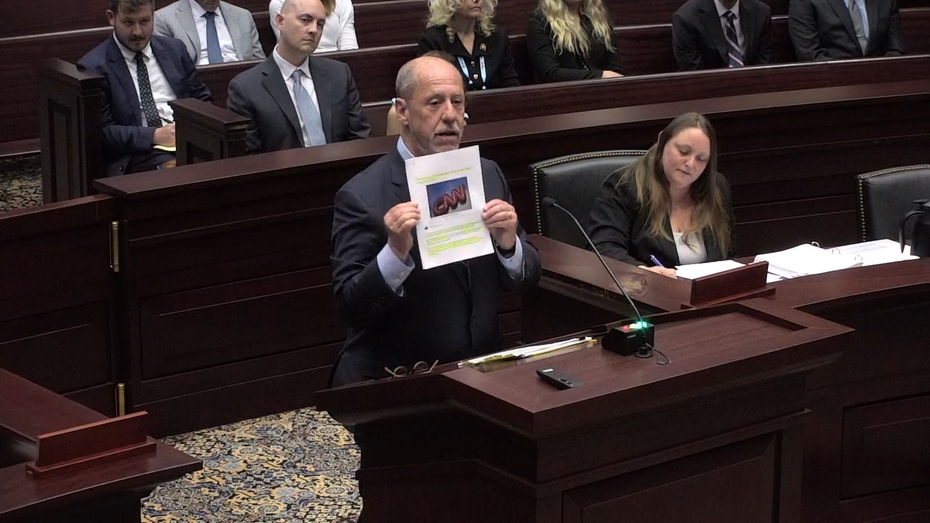
In the CNN case, the phrase “black market” was one of the contentious points Young successfully argued were defamatory against him. In an unsuccessful April 2024 appeal to the 1st DCA to overturn a ruling allowing Young to seek punitive damages, Tobin argued that a subjective use of the phrase be adopted (emphasis added):
Here, we're on a question of actual malice, express malice, and outrageous conduct measured by objective standards. Under that criteria, your honor, regardless of what the meaning may be in the dictionary, which is an objective definition. What plaintiff needed to show is that subjectively CNN intended that meaning, otherwise there is no facts in the record to give rise to a reasonable jury question about actual [malice].
“So, these are lawyers and professional writers that, you know, are used to dealing with words and have dictionaries and know how precise – what words mean?” pressed Judge L. Clayton Roberts.
Judge Thomas D. Winokur drilled down on the dictionary definition of “black market.” Tobin suggested it was simply just a “poor choice of words”:
WINOKUR: I hate to keep harping on this, but none of those things describe what could be commonly referred to as “black market.” I see Judge Roberts's point that “black market” clearly implies dictionary definition or otherwise, an illegal exchange of goods.
TOBIN: Your honor.
WINOKUR: That has nothing to do with those other descriptions in the chyron.
TOBIN: If it was a poor choice of words, your honor, and at best, we argue that it was at best a poor choice of words, your honor. That may have an impact on the rest of this case below under negligent standard, actual malice.
Young’s lead counsel Vel Freedman of Freedman Normand Friedland LLP made swift work of CNN’s argument:
So, what CNN is claiming is they took a word from the English language that has one definition and they meant when they said “black market,” they actually meant “grey market,” but they said “black market” that has one definition. CNN can't get up there and say, “Hey, Mr. Young is a serial killer,” but actually mean that he was a good Samaritan, but they only knew that in their head.
Fast forward to June 9, 2026, speaking to the same Judge Roberts on behalf of the AP, Tobin was argued that the AP’s stylebook - essentially their own dictionary - should not be looked to for the objective definition of the word “smuggle” which Young pointed to in his lawsuit (emphasis added):
ROBERTS: The AP publishes something called the AP Style Manual, correct?
TOBIN: Correct.
ROBERTS: And it defines “smuggling,” and the definition that the AP publishes for their reporters to use, and lots of other people use it, it says “smuggling” is an illegal activity.
TOBIN: It says, “human smuggling” is an illegal activity, or “people smuggling,” the whole point of defining a term, Your Honor, we do this in our briefs every day, is to use the term consistently from case-to-case moment-to-moment within it as you're walking through a brief.
The AP did not use the terms in its Stylebook. The Stylebook is inapt as, it is inapplicable to the circumstances of this case.
In a defamation hearing today, AP's lawyer argues to a panel of judges that their style guide doesn't matter.
— Nicholas Fondacaro (@NickFondacaro) June 9, 2026
He argues that it's okay the AP didn't follow their own guidelines when they used a word their book gives a negative meaning that implied illegality to describe the… pic.twitter.com/vmVbu0ijtk
“We just heard the attorney for the Associated Press get up here and say that its stylebook, which is a handbook for journalists, for students worldwide, does not apply to this case, that its reporter should not be held to what it says,” Young’s counsel Lisa Glass proclaimed when it was time for her rebuttal. “Words matter. The AP created its own stylebook to ensure that.”
Further, Tobin got philosophical about how to define words:
And Your Honor, we haven't talked yet about Judge Winokur's question, which I think does drive the decision that the court should reach here, which is, how do you read something? What are the tools that the court uses to read something when somebody argues that they're all avail themselves of more than one meeting?
“And what you do is you look to the context for the defamatory meaning question, you look to the context of the entire publication,” he answered himself.
How the media defend themselves in court gives insight to how the media operate in their newsrooms and editorial meetings. Words apparently have no objective meaning; they have one meaning in their reports and other in the courtroom.