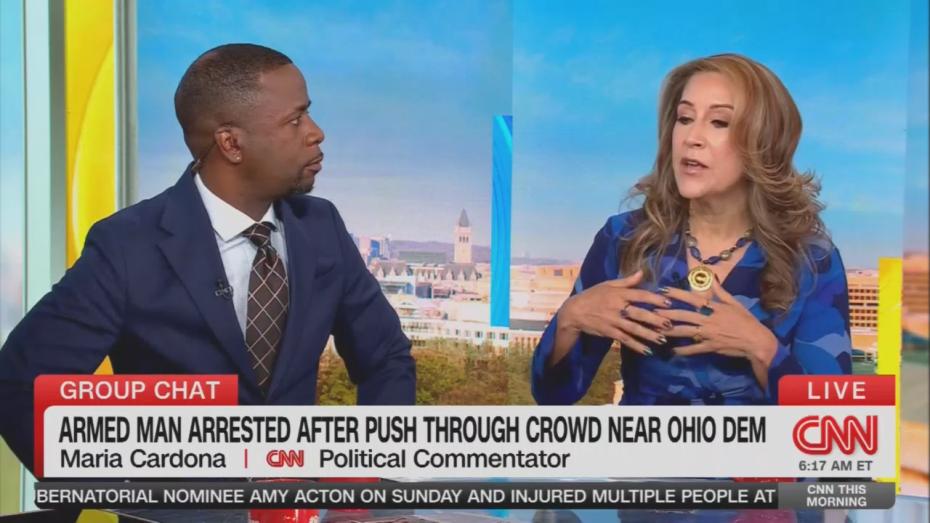
CNN political commentator Maria Cardona couldn't resist taking a shot at President Trump — even when the topic was politicians as the targets of violence.
On Monday's CNN This Morning, the subject was an incident at an event in Canfield, Ohio, for Democratic gubernatorial candidate Dr. Amy Acton. A man pushed into the crowd, injuring two before being arrested and found with two pistols and brass knuckles.
Host Audie Cornish asked Republican strategist Melik Abdul whether President Trump should acknowledge the incident. Abdul said that although Trump should, he probably won't, because: “Even when he's gone through it, the immediate conversation was, what did Donald Trump do to actually encourage that? The conversation was about Donald Trump. It wasn't about him as a victim. It was about him, almost as if the perpetrator.”
Cornish then played a clip of Charlamagne tha God from shortly after the White House Correspondents' Dinner attack, that our own Nick Spinnato caught at the time:
“Whenever there is some type of political violence that happens at, you know, one of these events, people always say, so are we going to tone down the violent rhetoric towards Trump? Stop it! Like, I’m sick of that narrative. I need every single media personality to direct that energy and that question towards one person and one person only, and that person is President Donald J. Trump. At what point do people simply say, Hey, Trump, it’s clear that you’re the drama?”
Abdul responded: “That's my point! That's literally my point.”
Cardona agreed with Charlamagne: “But Charlamagne is not wrong. That’s the whole point. Donald Trump has been one of the biggest perpetrators of the kind of talk and the kind of language that actually inspires some of these people to commit those kinds of violence.”
Charlamagne was telling every media personality to stop suggesting that violent rhetoric aimed at Trump should be toned down: “Stop it!” Cardona said he was “not wrong.” She thus endorsed a call to leave that violent rhetoric in place.
CNN's Cardona: Charlamagne Wasn't Wrong — Blame Trump for Violence Aimed at Trump! pic.twitter.com/aRqx43ua6Y
— Mark Finkelstein (@markfinkelstein) September 7, 2026
And while she may have meant “purveyor” or “propagator," she called Trump a "perpetrator." That is the word for the person who commits the act, not the person who was the intended victim.
So Cardona’s contribution was to declare Charlamagne “not wrong” — to hang “perpetrator” on the target — and to second a demand that violent rhetoric aimed at Trump not be toned down.
Who’s blaming the victim now, Maria?
Note: Despite describing reasons why Trump might be reluctant to condemn political violence directed at others, Republican Abdul emphatically concluded: "Absolutely, without any sort of equivocation: Donald Trump should condemn it. All Republicans should condemn these sorts of attacks."
Here's the transcript.
CNN This Morning
09/07/26
6:11 am EDTAUDIE CORNISH: An armed man pushes through a crowd during a campaign stop for the Democratic candidate for governor in Ohio, and two people were hurt. That man was arrested and charged with assault and disorderly conduct. A spokesperson for the candidate, Dr. Amy Acton, says that the man lunged towards her at a fair in Canfield. The suspect was later found to have two pistols and brass knuckles on him. Acton is running against Vivek Ramaswamy, and his team calls the incident unacceptable. This comes in an era of political violence, because obviously we've seen multiple assassination attempts on the president. We're nearing the one year anniversary of the assassination of Charlie Kirk.
(....)
6:14 a.m. Eastern
CORNISH: Is there a concern that, when you're bombarded with this kind of language, that's not policy critiques, but like, this is a bad person critiques; that that also contributes to a higher temperature.
SARA FISCHER: Could be. But those are not nearly the worst of political ads that I have seen. In fact, a big trend on TikTok is people making fun of ads, particularly in the South, for political ads, for just going after people's characters in such unprecedented ways, so that advertising tactic isn't new, Audie. I think what's new is that, you know, political violence continues to be so prominent, gets so much media attention that a lot of people, people with mental health issues, others are, you know, seeing more of it and they are getting inspired to take more action as it pertains to political events.
(....)
6:15 a.m. Eastern
FISCHER: And to Maria's point, when you're going out and you're running for office, that is now an assumed risk that you're going to be taking in a way it wasn't before. And I don't think you can blame the ads for that.
CORNISH: Should the President speak out regardless of what party the person is in? I think back when that lawmaker, I think it was in Minnesota, was shot, like, at her house, a lot of people said, why isn't he at least really acknowledging that this has happened, especially the way it did? And should he be speaking up whenever there's attack on a lawmaker? And do you think he does that?
MELIK ABDUL: Should he? Of course. He's the President of the United States. Will he? Probably not. Why? It's because of this, this, our political discourse is toxic as such.
CORNISH: But he's gone through it himself, right?
ABDUL: Yes. And even when he's gone through it, the immediate conversation was, what did Donald Trump do to actually encourage that? The conversation was about Donald Trump. It wasn't about him as a victim. It was about him, almost as if the perpetrator, so I don't expect — now Republicans, I would expect you would see Republicans, maybe outside of Donald Trump, speaking out against this, but you probably won't hear much from Donald Trump.
CORNISH: Yeah, here's an example of what you're talking about, maybe. Charlemagne tha God in April. This was after the attempted attack at the White House Correspondents' Dinner. And this is what he said a few days later.
CHARLAMAGNE THA GOD [on The Breakfast Club, 04/27/26]: When, whenever there is some type of political violence that happens at, you know, one of these events, people always say, so are we going to tone down the violent rhetoric towards Trump? Stop it! Like, I'm sick of that narrative. I need every single media personality to direct that energy and that question towards one person and one person only. And that person is President Donald J. Trump! At what point do people simply say, hey, Trump, it's clear that you're the drama?
ABDUL: That's my point! That's literally my point. Instead of — this was something that Donald Trump was victimized, to an extent, and he said, we should make this about Donald Trump. Don't start, don't stop going in after Donald Trump. Don't start [sic, stop] adding fuel to the fire at a time where Donald Trump was almost assassinated again. So, this is consistent with what Democrats have done over the years when it comes to Donald Trump. But yes, absolutely, without any sort of equivocation. Donald Trump should condemn it. All Republicans should condemn these sort of attacks, Donald Trump.
MARIA CARDONA: But Charlemagne is not wrong. That's the whole point. Donald Trump has been one of the biggest perpetrators of the kind of talk, and the kind of language, that actually inspires some of these people to commit those kinds of violence.
ABDUL: He didn't do anything to inspire the attack against him. He almost [inaudible].
CORNISH: Well, listen, you guys.
CARDONA: From the very beginning of his career.