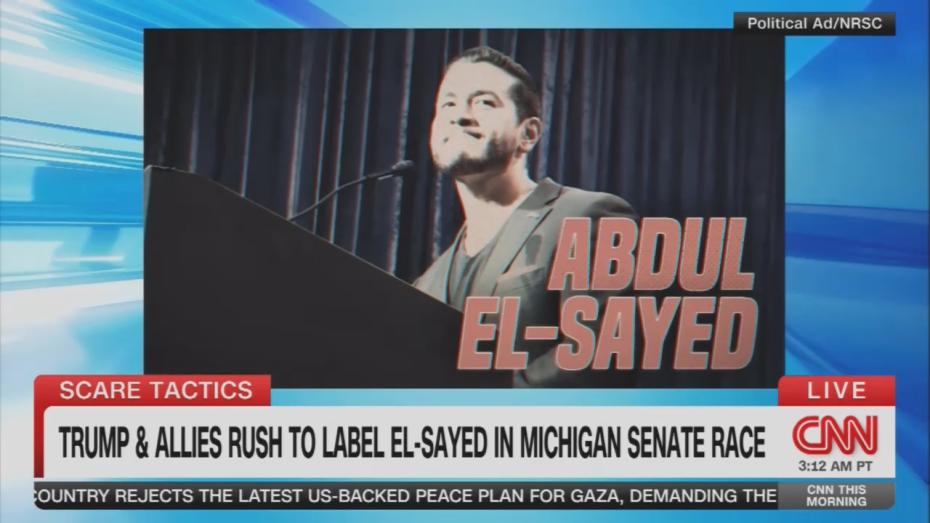
On today’s CNN This Morning, host Audie Cornish warned viewers of fear-mongering Republican spin about Michigan Democrat Senate candidate Abdul El-Sayed.
It is El-Sayed’s own record, statements, and associations with vile people like Hasan Piker that make him objectionable to many voters. But Cornish framed it aggressively:
CORNISH: Michigan's Abdul El-Sayed looks like the GOP's latest boogeyman. Will Red Scare tactics help Republicans win the midterms?
DONALD TRUMP: Abdul El-Sayed, lovely gentleman, is a man of hate, and now he's going around saying, "No, I love everybody, I love--" He doesn't love everybody.
CORNISH: So, have Republicans found their villain for the midterms?
It's obvious to anyone watching an hour of CNN that they have had a "boogeyman" and a "villain" with Trump for 10 or 11 years now, and have occasionally used "Hitler Scare" tactics.
The show then played an ad from the National Republican Senatorial Committee showing El-Sayed calling himself "pretty damn dangerous," and noting his pledged support for a leader of the Muslim Brotherhood. The U.S. government has officially designated branches of the Muslim Brotherhood as terrorist organizations.
Cornish then displayed Trump’s social-media post juxtaposing himself and Melania against El-Sayed and his hijab-wearing wife under the title “Two Very Different Americas.” Lulu Garcia-Navarro (formerly of NPR, now of the New York Times) accused Republicans of trying to “other” El-Sayed. She treated the hijab and the foreign-sounding name as illegitimate points of contrast rather than observable facts.
The GOP is not othering him. He’s doing it himself. A tiny fraction of American women wear the hijab, and it can be jarring to some. It's never concerning on CNN that Muslim voters might impose on American culture, but it's definitely concerning to CNN when Christians want to post the Ten Commandments in schools.
@AudieCornish Accuses Republicans of Making El-Sayed a 'Boogeyman and Villain'
— Mark Finkelstein (@markfinkelstein) August 10, 2026
Actually, El-Sayed is doing it all by himself with his own record, statements, and associations that make him objectionable to many voters—not some manufactured Republican scare campaign. pic.twitter.com/a0yhqRt4OQ
And panelist Tiana Lowe Doescher of the Washington Examiner noted El-Sayed's refusal to laud the elimination of the ayatollah at the beginning of the Iran war. El-Sayed was afraid it might offend the "many fans" the ayatollah had in the candidate's Dearborn base.
The show's chyron itself—“Scare Tactics”—revealed the network’s premise: that Republican criticism is unethical fear-mongering designed to falsely portray candidates like El-Sayed as extremists.
Again, a note to CNN: it's not a scare tactic to expose a candidate's own words.
Cornish closed by wondering whether, in an era of anger toward billionaires, it's fair to label someone a communist simply for that anger.
Not all billionaire-haters are communists. But every communist is a billionaire-hater—unless, of course, they themselves are the billionaires running the corrupt oligarchical regimes that result. Shades of Bernie Sanders' decades of denouncing "millionaires and billionaires" -- until it turned out he was a millionaire himself!
No, Audie: the GOP is not inventing a villain—it is simply documenting the persona El-Sayed has spent years becoming.
Here's the transcript.
CNN This Morning
8/10/26
6:12 am EDT
AUDIE CORNISH: And Michigan's Abdul El-Sayed looks like the GOP's latest boogeyman. Will red scare tactics help Republicans win the midterms?
DONALD TRUMP: Abdul El-Sayed, lovely gentleman, is a man of hate, and now he's going around saying, "No, I love everybody, I love--" He doesn't love everybody.
CORNISH: So, have Republicans found their villain for the midterms?
REPUBLICAN AD: Abdul Rahman Mohammed El-Sayed, the most radical senate candidate in America. [Clip of El-Sayed] "I'm pretty damn dangerous." El-Sayed pledged support for the leader of the Muslim Brotherhood, a designated foreign terrorist group.
CORNISH: So, we wanted to show you that, an attack ad, featuring El-Sayed's full name. The president also posted this image on social media titled, "Two Very Different Americas."
Now, I was interested in how he responded to the name back and forth, the sort of how he was characterized. It felt, a cousin to, but very different from the way Barack Obama handled it during his running, right, where it was constantly, "Barack Hussein Obama."
And he said something very different, right? He didn't say, "That's not, you know what I mean? What are they saying? They're trying to trick you." He was just like, "Yeah, that's me," and those other ones are really --
LULU GARCIA-NAVARRO: That is him. I mean, he is, you know, that, that is who he is, and I think he's right to lean into it and not away from it.
This is campaign season, this is, kind of -- The message that the administration's trying to put out here is that he is other, right?
This idea of those juxtaposing visions of America that Trump was trying to put up is like, "Look, she's got a scary hijab. Look at his name, it is foreign."
And I think, we no longer necessarily in that era where that is the most important thing that people are focusing on. People understand that there are Muslims among us, that there are people with Arab names among us, you know, that there are there are people of Egyptian descent among us, and so I think, that has less resonance.
TIANA LOWE DOESCHER: I mean, it's, recall that El-Sayed is the one who during the primary said that if you can't pronounce his name, it's racist, right? So he's, he started this. The NRSC is just jumping on it.
CORNISH: So you think they wouldn't have done it if he hadn't said that?
DOESCHER: I mean, I'm just saying, he lobbed the first shot. And look, correct that the White House is running on, the Dems are communists, they're socialists, whatever. But also, third worldism, which I think is inextricably linked with a lot of that messaging.
CORNISH: What does, define that for us so we understand?
DOESCHER: So Third Worldism, the idea that in order to, in order to appease the voters of Dearborn, which is largely Yemeni and Lebanese diaspora, that a, an American born citizen, Mohammed or Abdul El Sayed, could not criticize [sic] or, or laud the killing of the Ayatollah, right?
There was this was leaked audio where he said, "Oh, we don't wanna comment on it because, you know, the Ayatollah has a lot of fans in Dearborn." That is third worldism.
. . .
NICOLE MALLIOTAKIS: So let's call it what it is. It's communism!
LISA MCCLAIN: Think about what's happened in those countries where they've had socialism and communism. The press is the first one to go.
STEVE SCALISE: And communism is on the ballot this November against freedom. Make no mistake about that.
MIKE JOHNSON: We have been saying for months, you've heard me say, a contrast between common sense and crazy in the midterm. And now it's common sense versus communism.
CORNISH: I just wanted to play that because it's not the culture war argument of Third Worldism versus structural versus whatever. They're just like, "These are communists, full stop."
And what I'm wondering is, in an era when there is antipathy, if not outright anger, towards billionaires and moneyed classes, is that argument is just like harder to make, that if you are against billionaires, you're a communist?