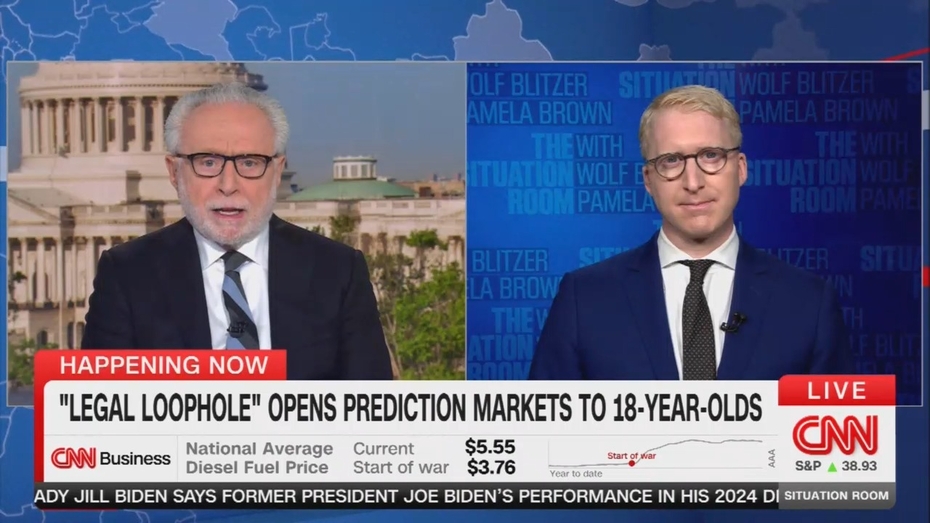
As prediction markets like Polymarket and Kalshi become a more and more pervasive part of modern sports, culture, and news, CNN accused Trump of letting them run loose over American society. On this Thursday’s episode of Situation Room, senior reporter Marshall Cohen highlighted President Trump’s battles against state regulation measures while conveniently omitting his endorsements of the existing federal regulation body in their stead.
The segment begins with co-host Wolf Blitzer and Cohen discussing the issues surrounding prediction markets and the ways they are treated differently than proper gambling, being labelled as a “loophole” used to avoid the usual 21-year-old requirement for traditional gambling. They discuss the risks these markets pose to these users under 21:
COHEN: Wolf, you're right that some are indeed calling this a potential public health crisis, we're talking about prediction sites like Kalshi and Polymarket. You can bet on nearly anything, like you mentioned, from sports to elections and entertainment and beyond.
Most people probably don't realize that this is not technically considered gambling. They are regulated like financial markets under federal law, like crypto and day trading. And that means they're available to anyone over 18. Critics say this is a loophole because in most states you must be 21 to use a sportsbook and bet on the same exact games.
Of course, Cohen can’t stay objective for long, and the moment Donald Trump is brought up, objectivity and good reporting flies right out of the room:
Now, earlier this week, President Donald Trump said he fully supports the prediction industry and his administration has been aggressively taking steps to stop states from regulating these sites, like gambling.
Cohen is likely referring to President Trump’s May 26th Truth Social post, which says, “It [prediction markets] is a major Industry, and we must protect it.” This is among other points he makes regarding prediction markets and cryptocurrencies.
From CNN’s characterization of the issue, it would seem that Trump wants to make prediction markets into some sort of “Wild West” for investors and gamblers, yet with proper context it is clear that this is nowhere near his actual stance on the matter.
His battle with state legislatures is to maintain one unified federal system that prediction markets will operate under, rather than having rogue Democratic governors dictating state policies willy-nilly.
This same CFTC is seeking to expand regulations regarding prediction markets, as announced by CFTC Chairman Michael Selig all the way back in January. The same day as Trump’s post about prediction markets, a proposal was submitted for White House review, also concerned with the regulation of prediction markets and consumer protection specifically.
So no, Donald Trump is not, as characterized by CNN, leaving the prediction markets to run rampant on their own. What else would we expect from one of the pillars of the Democrat media cabal?
To their credit, they at least had the dignity to disclose their partnership with Kalshi, one of the largest predictive market platforms on earth. Maybe next time, they should expand this honest reporting to the rest of their show!
The transcript is below. Click "expand" to read:
CNN’s The Situation Room
May 28, 2026
11:39:37 a.m. Eastern
(...)WOLF BLITZER: And for 18 to 21-year-olds, most gambling is illegal unless you turn to prediction markets. They are sites that allow users to purchase event contracts, more simply put, critics say it's a legal loophole, and it allows young adults over 18 to make bets on things like sports and pop culture.
Let's go to CNN's senior reporter, Marshall Cohen, who’s working this for us. Marshall, addiction experts and state officials are warning that this so-called loophole could fuel a public health crisis. What more are you learning?
MARSHALL COHEN: Wolf, you're right that some are indeed calling this a potential public health crisis, we're talking about prediction sites like Kalshi and Polymarket. You can bet on nearly anything, like you mentioned, from sports to elections and entertainment and beyond.
Most people probably don't realize that this is not technically considered gambling. They are regulated like financial markets under federal law, like crypto and day trading. And that means they're available to anyone over 18. Critics say this is a loophole because in most states you must be 21 to use a sportsbook and bet on the same exact games.
Now, we've heard from young people, including some still in high school, who say they've become addicted to prediction markets. At first, it was fun betting on things that they're passionate about to earn extra cash, to pay for vacations and nice dinners. But addiction specialists say the brain just isn't fully developed at age 18. You take more risks, you might not consider the consequences of all your actions, and experts have warned that this is especially true among young men.
Now, earlier this week, President Donald Trump said he fully supports the prediction industry and his administration has been aggressively taking steps to stop states from regulating these sites, like gambling.
In the meantime, Kalshi has voluntarily imposed some safeguards that they say will protect younger users, like encouraging deposit limits or requiring proof of funds. And I actually recently spoke about this with Kalshi’s head of product, Catherine Sullivan. Here's what she said. Take a listen.
[Cuts to audio]
CATHERINE SULLIVAN: It's more so in terms of suggestions and gentle guardrails – more so than policing our users, which we never want to do. If we see that our younger users are losing a certain amount of money, we start triggering alerts to them. Who are we to really like, police what people can do once they turn 18? Like, these are the principles with which the country was founded.
[Cuts back to live]
COHEN: Now, Kalshi says, only four percent of its total trading volume comes from this 18 to 21 cohort. But Wolf, consider this: Kalshi sees about $4 billion in total volume every week. Meanwhile, the biggest rival to Kalshi, Polymarket, they became widely available in the U.S this month. They've been on a marketing blitz. Their ads are all over social media. I've been getting them nonstop on my TikTok, and they've partnered with the very popular influencer Logan Paul, who has a massive following with younger Americans.
Polymarket declined to comment for this story. And Wolf, for full disclosure, CNN, of course, we have a partnership with Kalshi. We use its data to cover major events, but CNN employees are not allowed to use prediction sites.
BLITZER: All right. Marshall Cohen reporting for us. Thank you very, very much. And by the way, if you or someone you know has a gambling problem, call the National Council on Problem Gambling. The help line at 1-800-MY-RESET. 1-800-MY-RESET.
Coming up…
(...)