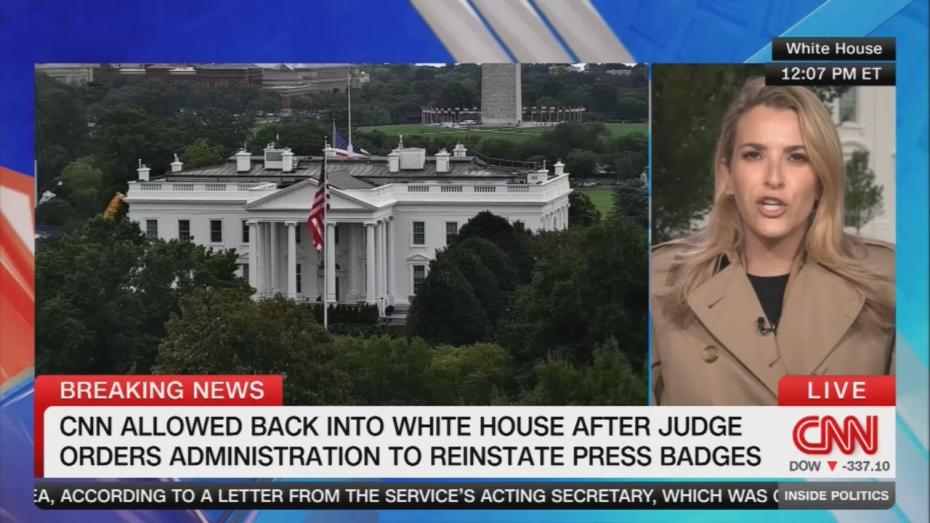
UPDATE, 12:30 p.m. Eastern: Shortly after noon Eastern, the White House complied with a federal court order to allow CNN, MS NOW, and Politico reporters back onto the grounds, nearly 12 hours after Judge Timothy Keller issued the ruling.
Predictably, CNN and MS NOW are acting as if being allowed back on the White House grounds is akin to Washington crossing the Delaware or Americans storming the beaches of Normandy.
Here was how it unfolded on CNN:
Truly, Washington crossing the Delaware-like breathless enthusiasm about CNN reporters walking back onto White House grounds pic.twitter.com/3sM2VoFOEH
— Curtis Houck (@CurtisHouck) September 24, 2026
And this was how CNN found out its team was back at their position on the North Lawn:
Martyrdom, not humility.
— Curtis Houck (@CurtisHouck) September 24, 2026
Opposition party, not adversarial coverage.
CNN playing their return to the White House like it's the Zapruder film pic.twitter.com/WGPK0N51qt
So, yes, CNN played its return to the White House like the Zapruder film. These people relish martyrdom instead of humility. They are the opposition party, not independent journalists providing adversarial coverage.
Over on MS NOW, Peter Alexander began a special second hour of State of Play with the announcement:
Here was how MS NOW covered their return to the White House, nearly 12 hours after the court order pic.twitter.com/KiIZBt9Wn2
— Curtis Houck (@CurtisHouck) September 24, 2026
The original post follows below.
------------------------------------------------------------------------
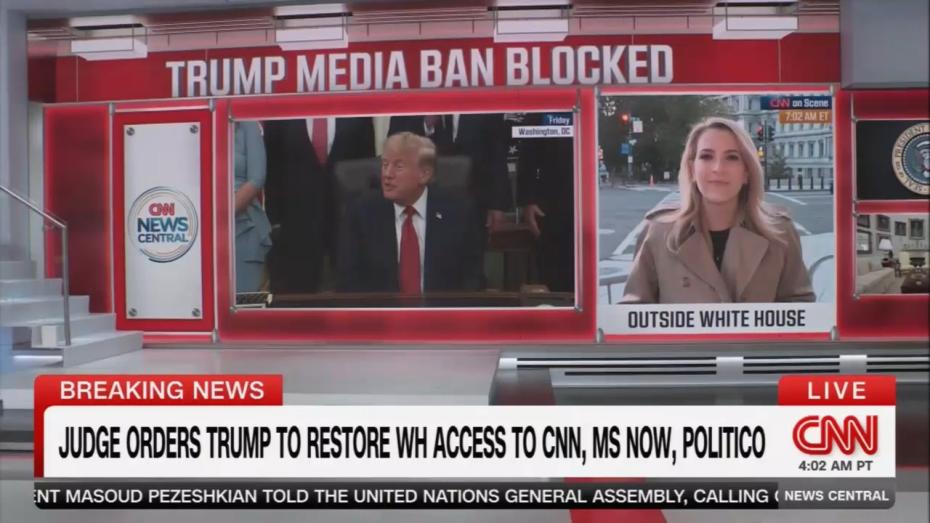
In the early hours Thursday, D.C. District Court Judge Timothy Kelly ruled for CNN, MS NOW, and Politico in their lawsuit against the Trump administration after the President announced Friday they were banned from the White House. Kelly said they had “shown a likelihood of success, at least on their Fifth Amendment procedural due process claim” of being barred without notice or chance to appeal.
Kelly leveled a “Temporary Restraining Order” to “remain in effect for 14 days, and the Court will set a schedule for expedited briefing on a motion for a preliminary injunction during that time. The Court will then be able to consider such a motion with additional time and on a fuller record.”
But when reporters from the three liberal outlets returned to the White House Thursday morning, they were turned away, setting up a legal showdown with Kelly giving the Justice Department until 12:30 p.m. Eastern to explain why the administration defied his order.
At 1am ET, a judge ordered the Trump admin to restore White House access to CNN, MS NOW and Politico. As of 9am, CNN correspondent @betsy_klein has still not been allowed back to her workspace at the WH. "It appears that the White House may be in defiance of this court order..." pic.twitter.com/D0JjjiA2tY
— Brian Stelter (@brianstelter) September 24, 2026
Surprisingly, Kelly did not weigh in on whether the three outlets have a constitutional right under the First Amendment to have hard passes to come and go from 1600 Pennsylvania Avenue.
But on the Fifth Amendment claims, Kelly said this. Notice the allusion in one citation to the 2019 case against first Trump term carnival barker Brian Karem:
The merits of this claim are assessed in two steps: “the first asks whether there exists a liberty or property interest which has been interfered with by the State; the second examines whether the procedures attendant upon that deprivation were constitutionally sufficient.” Ky. Dep’t of Corr. v. Thompson, 490 U.S. 454, 460 (1989) (citations omitted). Plaintiffs have shown they are likely to succeed at both steps. As for the first, the D.C. Circuit held in Sherrill v. Knight that “the interest of a bona fide Washington correspondent in obtaining a White House press pass . . . undoubtedly qualifies as [a] liberty [interest] which may not be denied without due process of law under the fifth amendment.” 569 F.2d 124, 130–31 (D.C. Cir. 1977). And if there were any doubt about what Sherill meant, the D.C. Circuit more recently reaffirmed this conclusion in Karem v. Trump, holding that “a duly issued hard pass may not be suspended without due process.” 960 F.3d 656, 665 (D.C. Cir. 2020).
Plaintiffs are also likely to succeed in showing that their hard passes were revoked without constitutionally adequate due process. The “general rule” is that “individuals must receive notice and an opportunity to be heard before the Government deprives them” of a constitutionally protected interest. UDC Chairs Chapter, Am. Ass’n of Univ. Professors v. Bd. of Trs. of the Univ. of D.C., 56 F.3d 1469, 1472 (D.C. Cir. 1995) (quoting United States v. James Daniel Good Real Prop., 510 U.S. 43, 48 (1993)).
Aiming for the Justice Department, Kelly said they “do not dispute that Plaintiffs did not receive notice and an opportunity to be heard before their hard passes were revoked.”
In fact, he declared “none of Defendant’s arguments convince the Court that Plaintiffs are not likely to succeed on their due process claim,” noting the crux of the government’s court filing relied on its belief that landmark court cases about press freedom were wrongly decided.
“Maybe—but this Court is bound by D.C. Circuit precedent, full stop,” Kelly said.
Much of Wednesday afternoon’s hearing revolved around the administration’s official filing claiming the three outlets must be barred because of past reporting that threatened national security.
Kelly said not only were the stories cited “routine,” but this was “not so ‘extraordinary’ as to permit deviation from the ‘essential principle of due process’ that a deprivation of liberty ‘be proceeded by notice and opportunity for hearing.’”
This was perhaps the closest Kelly came to weighing in on the claims about press freedom (click “expand”):
The final two factors, the balance of the equities and the public interest, also favor Plaintiffs. These two factors “merge when the Government is the opposing party.” Pursuing Am.’s Greatness v. FEC, 831 F.3d 500, 511 (D.C. Cir. 2016) (citation omitted). As the Court has concluded, the revocation of Plaintiffs’ hard passes likely violated their constitutional due process rights, and “enforcement of an unconstitutional law is always contrary to the public interest.” Karem, 960 F.3d at 668 (citation omitted). Moreover, Plaintiffs—and the public—have an abiding interest in maintaining the status quo ante given the importance of the free press, which “stands as one of the great interpreters between the government and the people.” Grosjean v. Am. Press. Co., 297 U.S. 233, 250 (1936).
On the other side, Defendants argue that revoking Plaintiffs’ hard passes and excluding them from the White House serves an important national security purpose, citing Defendants’ interest in “protecting classified and sensitive national security information.” No doubt, protection of the national security is a weighty interest on the Executive’s part...Still, on this record, Defendants offer little to back up their asserted national security interest to justify revocation of Plaintiffs’ hard passes.
“[T]he record lacks factual support for Defendants’ contention that the revocation of Plaintiffs’ hard passes will in fact protect national security or that national security will be endangered if the Court orders their passes reinstated...Defendants offer no declarations or other support...explaining how any of the reporting they identified...damaged the national security,” he added.