Appearing on Monday's On the Line, MS NOW contributor Jason Johnson declared that Supreme Court Justice Sam Alito will have a "terrible" legacy, and compared him to a "burglar" who has taken rights away from Americans.
After showing a clip of CBS News reporter Jan Crawford asking Justice Alito about the possibility that he will retire in the near future, and whether an unplanned departure might threaten the work he has done, Menendez went to MS NOW legal analyst Joyce Vance and read from an item she published on Substack.
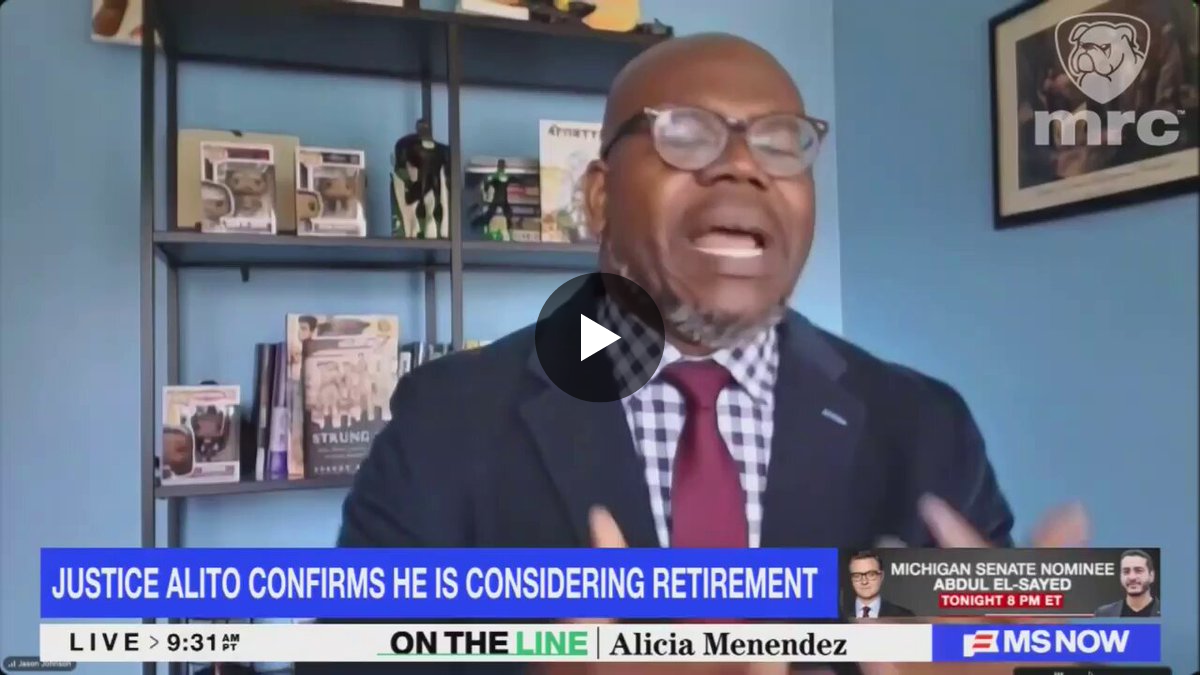
MS NOW's Jason Johnson Compares Justice Alito to a Burglar pic.twitter.com/apfHhrR7ne
— Brad Wilmouth (@bradwilmouth) October 5, 2026
The MS NOW host posed: "You mentioned your, quote, 'list of dreads' that SCOTUS could decide on this term -- on the agenda, elections, guns, LGBTQ rights, immigration. What could be the most consequential case they're hearing?"
Vance fretted about the possibility of more right-leaning court rulings:
The problem is the Supreme Court has a rich panoply of opportunity to undo important American rights this term. But I think for those of us who believe that -- that we are a country that's always trying to be better than what we've been in the past, it's the immigration cases that stand out and the ability of the United States, for instance, to deport people to third party countries that they have no ties to, even when those are countries like South Sudan that are war torn and dangerous. If the Supreme Court signs off on that, it'll be difficult for Americans to appreciate who we've become as a country.
After Menendez went to Johnson and asked if he believed Democrats could make the Supreme Court an issue, Johnson essentially complained because Crawford did not act like a partisan liberal in her interview with the conservative justice:
One, I have to say this just professionally: That was a horrible question that was asked of him to sort of ask Alito, well, "Don't you worry about all the work that you've done being undone?" Oh, you mean the work of snatching away rights and snatching away things that you would establish as precedent for the last 50 years because you want to serve your political masters? His legacy is going to be terrible on the -- on the court because of the kinds of things that he did. This is not the kind of question that you should be asking someone who's supposed to be adjudicating in an objective manner.
Liberals demand that every interviewer should yell at the conservatives that they're horrible people. He then continued:
But here's the other thing that's important. For him to say over the course of this interview, "Well, I'm concerned that the court's being intimidated and court expansion" -- it's essentially like a burglar in your house saying, "Hey, I'm sick and tired of all these conversations about burglar alarms. What's going on?" The American people have decided that only 46 percent of us even trust this court. So court reform is absolutely essential, either expanding the court or increasing the number of ethics guardrails that we have so we don't see the kind of outlandish behavior we've seen over the last eight years, both in the selection of people to be on the court and in their actual adjudication and behavior.
Transcript follows:
MS NOW's On the Line
October 5, 2026
12:30 p.m. Eastern
ALICIA MENENDEZ: Democrats hope they'll win a Senate majority in November, providing a check on Trump's nominees for his remaining two years in office. Let's bring in MS NOW legal analyst and former U.S. attorney Joyce Vance. Jason Johnson and Marianna Sotomayor are still with us. Joyce, I promised our audience day one that we would focus on the stakes on your Substack. You were doing just that. You mentioned your, quote, "list of dreads" that SCOTUS could decide on this term -- on the agenda, elections, guns, LGBTQ rights, immigration. What could be the most consequential case they're hearing?
JOYCE VANCE, MS NOW LEGAL ANALYST: You know, all of the above, right? I mean, the problem is the Supreme Court has a rich panoply of opportunity to undo important American rights this term. But I think for those of us who believe that -- that we are a country that's always trying to be better than what we've been in the past, it's the immigration cases that stand out and the ability of the United States, for instance, to deport people to third party countries that they have no ties to, even when those are countries like South Sudan that are war torn and dangerous. If the Supreme Court signs off on that, it'll be difficult for Americans to appreciate who we've become as a country.
MENENDEZ: Jason, do you think there's an opportunity to make this a midterm issue?
JASON JOHNSON, MS NOW CONTRIBUTOR: Absolutely. And I think engage voters in Michigan, in North Carolina, in Texas. This is the sort of thing they have to care about because, hey, the Supreme Court is now a key issue. It's something that for 10 years, sort of elite political people have been trying to make a part of campaign conversation. But after the end of Roe versus Wade in 2022, I think everybody pays attention. But there's two things about this, Alicia, that are really important.
One, I have to say this just professionally: That was a horrible question that was asked of him to sort of ask Alito, well, "Don't you worry about all the work that you've done being undone?" Oh, you mean the work of snatching away rights and snatching away things that you would establish as precedent for the last 50 years because you want to serve your political masters? His legacy is going to be terrible on the -- on the court because of the kinds of things that he did. This is not the kind of question that you should be asking someone who's supposed to be adjudicating in an objective manner.
But here's the other thing that's important. For him to say over the course of this interview, "Well, I'm concerned that the court's being intimidated and court expansion" -- it's essentially like a burglar in your house saying, "Hey, I'm sick and tired of all these conversations about burglar alarms. What's going on?" The American people have decided that only 46 percent of us even trust this court. So court reform is absolutely essential, either expanding the court or increasing the number of ethics guardrails that we have so we don't see the kind of outlandish behavior we've seen over the last eight years, both in the selection of people to be on the court and in their actual adjudication and behavior.