Legalized homicide is now the cause of one out of every 20 Canadian deaths.
The country’s “medical assistance in dying” regime — MAID — has been in effect for 10 years and has taken an estimated 100,000 lives.
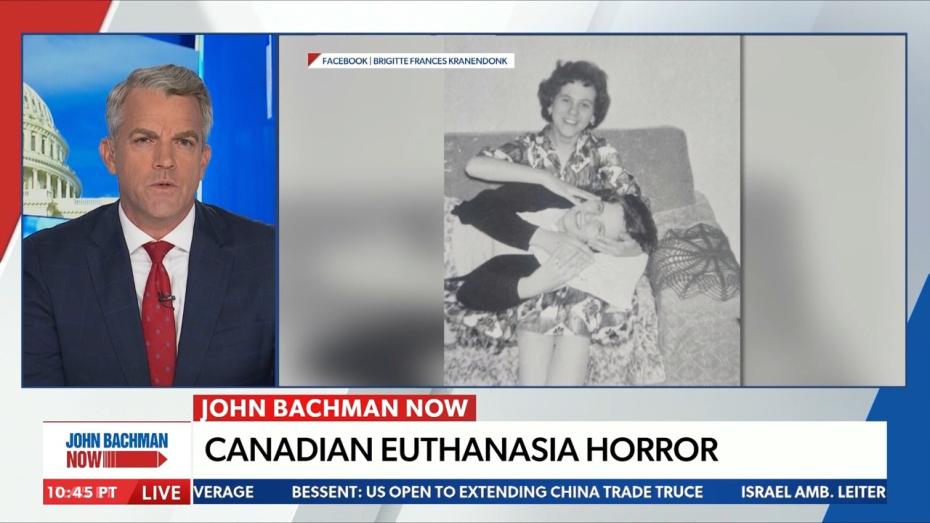
The numbers, and shocking stories like Brigitte Stegemann’s, are a warning to America of what the euthanasia movement has in store for us.
Stegemann was an 83-year-old woman who did not understand that the procedures she allegedly consented to would lead to her death.
According to her granddaughter, when she explained to Stegemann what was going to happen, the elderly woman started crying and said she’d made a mistake.
She was put to death anyway on July 10, over her granddaughter’s objections.
The old and ill are vulnerable — even young and mostly healthy individuals know that hospitals and other medical facilities can be high-pressure environments in which people who are sick or in pain can’t always make clear and well-considered decisions.
Patients are weak; medical establishments and their administrators are comparatively strong, so much so that even hints and suggestions can be taken as commands by the infirm or excessively trusting.
In the context of euthanasia, there are no safeguards that can prevent killing without consent. The only variable is how often it happens.
Yet homicide with consent is an abuse in itself, placing the medical profession in the service not of life but of death.
With healthcare systems as bureaucratic as those of America and Canada — and the rest of the Western world — the decision to kill might as well be made by a machine, and in the name of efficiency, it probably won’t be long before artificial intelligence is calling the shots, even when they’re the lethal injections.
It’s true that medicine can now prolong life without restoring health, making dying a lengthier process than it may once have been.
As our population gets older, the right care for those nearing the end of their lives will become an ever bigger issue.
But killing isn’t care, and the convenience that overburdened medical systems may find in eliminating high-cost patients will give rise to motives for euthanasia that are fundamentally mercenary.
Is anything in modern medicine a model of highly personal relationships between patients and doctors?
If there’s no deep human investment in anything else, what would make euthanasia any different?
Whatever humanitarian rhetoric it may be dressed up in, killing by physicians will be just as impersonal as all of today’s treatments are.
Cases like Stegemann’s in Canada already show this to be, and there are examples to be found wherever euthanasia has found a legal haven.
That includes at present 13 American states — among them New York, Illinois and California — and European nations such as Spain, Belgium and the Netherlands.
Significantly, all but one of the states that have so far embraced “death with dignity” are Democratic-leaning blue states: Republican-leaning Montana is the sole exception.
If Democrats win big in federal and state-level elections this November, they’ll make America more like Canada at every opportunity, including where “assisted suicide” and euthanasia are concerned.
When Bill Clinton said he wanted abortion in America to be “safe, legal and rare,” what he meant was that it should be legal up to birth — or afterward, in the case of partial-birth abortions — terminal for the unborn, and available on demand.
Don’t buy a sales pitch for euthanasia that uses similar language:
It won’t be safe or rare once it’s legal.
It may not be the top priority for a Democratic Congress, but it will only be a matter of time before euthanasia and related practices are being made the law of the land nationwide, not just in blue states.
Canada has crossed an ethical line no civilized nation should trespass.
Yet there’s nothing to stop this murderous idea at the border — and there are people here who would welcome the Canadian system.
The time to reject it is now, before it can gain greater purchase in this country.
Medical assistance in dying is not only a mortal danger to the most vulnerable members of society, it’s deadly to the very principles of human dignity that our society is founded on.
Like the medical profession, the law exists to protect life, not hasten death, and inverting the law’s purpose is itself a form of a suicide for nations, not just individuals.
Daniel McCarthy is the editor of Modern Age: A Conservative Review. To read more by Daniel McCarthy, visit www.creators.com.