As we approach the third anniversary of Hamas's barbaric terror attack against Israel, the left wing media continues to steadfastly portray Israel as the bad guy, while Hamas is hardly ever referred to as the terrorists they are. Many believe this bias has developed over time as the situation in Gaza remains unresolved, but a recent study shows that in the case of the New York Times, that's not true.
Edieal Pinker of the Yale School of Management published a study in the Studies in Conflict And Terrorism journal last week, where he reviewed coverage of the war between Israel and Hamas from October 7, 2023 through June 7 2024, reviewing 1,559 news articles presented in the New York Times. What he found, while not surprising, is most revealing and hard to digest. Pinker wrote:
I document a dominant narrative consistent with a framing that assigns near-exclusive agency and responsibility to Israel while diminishing Hamas’s role in sustaining the conflict. It describes Hamas’s October 7 attack followed by Israeli military violence and mounting Palestinian casualties, while largely omitting Israeli casualties post-October 7, Hamas fighter casualties, and post-October 7 Palestinian violence. Personal accounts of Palestinian suffering appear two out of every three days, while comparable accounts of Israeli suffering rarely appear.
For example, within three weeks, they made a video on the suffering of Gaza's children. Pinker finds that giving Israel the victim status they deserved was very brief. It lasted all of one day.
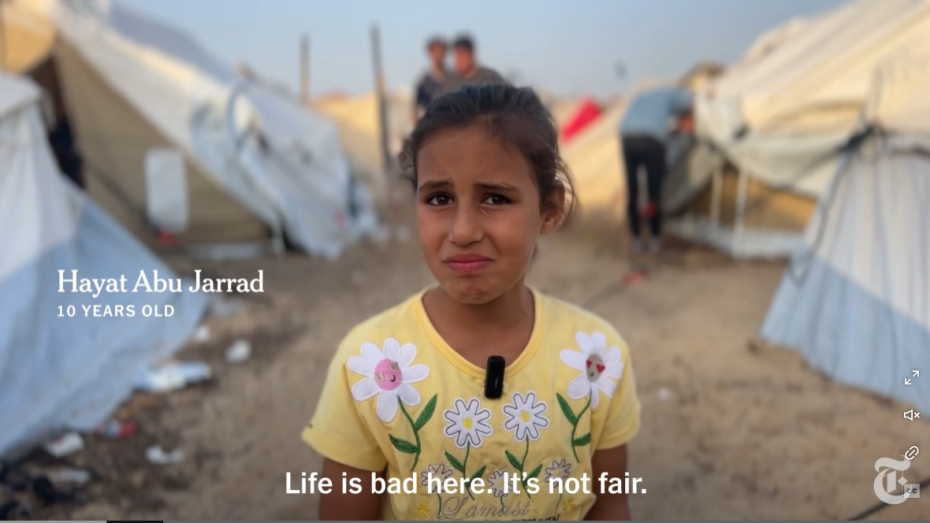 Screenshot of video at NYTimes.com
In this narrative, on 7 October 2023, Hamas perpetrated a brutal assault on Israel that subjected a mainly civilian population to horrific atrocities and from 8th October 2023, onward Israel has been the sole aggressor that seemingly bears no costs from conducting the war except for a loss of international support and public sympathy, particularly among young people and the political Left.
Meanwhile, post October 7th, Palestinians are portrayed as passive victims whose suffering grows daily as they are relentlessly attacked by the Israeli military. I argue that the framing that emerges from this narrative offers a distorted view of the conflict.
Pinker says, that distorted reporting can be most persuasive in placing blame.
Common sense suggests that readers exposed to this reporting pattern and framing will be influenced in the direction of certain beliefs and attitudes. For example: Israelis are not incurring significant cost from the war, Israel bears all of the responsibility for what is happening on the ground, and the war is achieving little purpose other than to inflict death and misery on the Palestinians of Gaza and thus Israel is acting unjustly. As a result, the war must be ended at any cost and Israel must be forced to do that with external pressure. A corollary of the above is that it becomes easier to vilify Israel and its supporters as immoral.
Pinker also says his study shows hardly any mention of the 251 Israeli hostages taken by Hamas.
You might be saying, alright, we know the media and the N.Y. Times are biased, so what? But as Pinker explains, selective coverage and media bias have serious implications.
It is my hope that the analyses presented in this study help increase understanding of how choices in what to cover can create an imbalanced perspective of an important issue. The result of these choices can be to shift a newspaper, in this case the NYTimes, from being a reporter of the news to a manufacturer of the same.
Great job by Pinker. Of course this goes way beyond The Times and Israel. The concerns expressed about The Times becoming a manufacturer of news can be extended to most of the liberal media and most issues of concern.