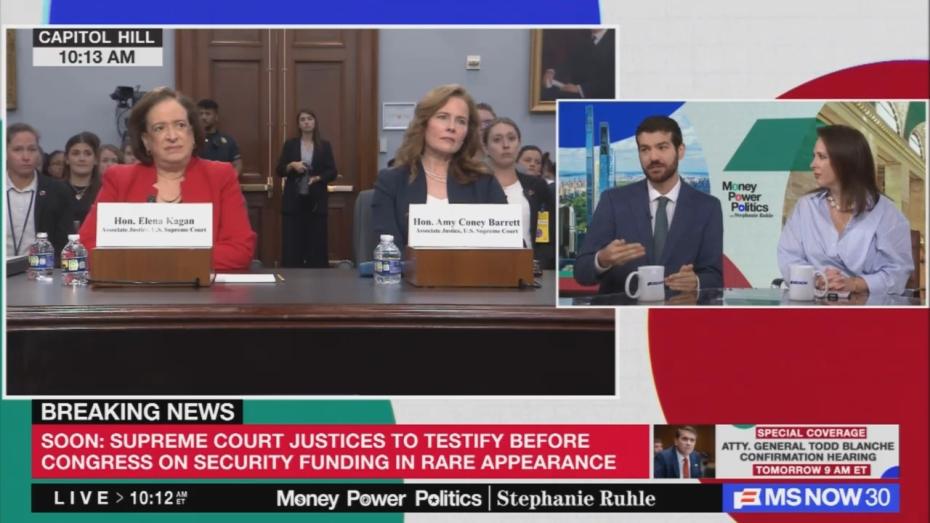
In recent years, Supreme Court Justices have been repeatedly harassed for their rulings and stances, and there have even been attempts on their lives by leftist extremists. This Tuesday’s MS NOW Money, Power, Politics with Stephanie Ruhle covered a Congressional hearing regarding an increase to the Justices’ security budgets. After a cursory overview of the situation, the discussion turned towards Congress’ relationship with the Supreme Court.
Somehow, in this hearing about the threats faced by Supreme Court Justices, Slate senior writer Mark Joseph Stern was able to twist the discussion into how Congress could join the fray, suggesting that they too should threaten the Supreme Court:
I think they do need that reminder from time to time, when they're sitting in judgment up on their Mount Olympus and their marble palace that, you know, at the end of the day, Congress still holds the cards. Congress could take away their funding. Congress could strip jurisdiction. Congress could abolish every seat except the Chief Justice’s if it wanted to. And so if they forget that, it starts to lead to a place of arrogance, it starts to lead to a lack of humility.
MS NOW arguing that Congress should use its power of the purse to hold the Supreme Court hostage. So much for separation of powers!
The left doesn't care about the rule of law, they only care about how they can use the law to further their own political ends. pic.twitter.com/Xj9u9QBxIk— James Waterman (@jwatermaniv) July 14, 2026
Stern suggested that Congress’s authority over the finances and procedures of the Supreme Court should be used as a cudgel against the Court. He even argued that they should consider removing the Justices’ access to the Supreme Court building altogether:
It still, as we see today, relies on Congress for funding, relies on Congress for the ability to have security, for the ability to actually continue to exist in its own building, which the Supreme Court didn't have until less than 100 years ago. It used to operate out of the Capitol because it didn't have its own digs.
And I actually think it was a little bit healthier for our country when the Supreme Court still had to look over its shoulder and ask Congress for funding for a building, for all of this stuff that reminded it, hey, we need the political branches to exist and survive. And so perhaps we shouldn't run so roughshod over the handiwork of those branches.
Essentially, he argued for the subordination of the Supreme Court to Congress. Obviously, this flies directly in the face of the separation of powers established by the Constitution.
MS NOW legal analyst Barbara McQuade would later build on Stern’s suggestions, downplaying the issue of the separation of powers and arguing that Congress could enforce a nebulous ‘ethics code’ upon the Supreme Court:
Sometimes the Chief Justice has said, “there can't be any ethics code. We can't be beholden to Congress about ethics enforcement because of separation of powers issues. That's absolute nonsense. As will be demonstrated today, the Court is beholden to Congress for funding, for its budget, for its building, for its salaries. Why not for its ethics?
Of course, the examples McQuade cites were the purported misconduct reported by the far-left ProPublica, which almost exclusively targeted the conservative justices. She didn’t cite any examples of how liberal justices like Justice Sotomayor sat on a case that directly involved the publisher of her book.
The MS NOW cast don’t seem to care much for the separation of powers or Constitutional order, and it provides a lot of insight into what they really believe about the government. They interpret Congress’ power of the purse as a political tool, rather than a responsibility. To them, it’s something they can abuse to force the Court into line.
To MS NOW, and the wider leftist media movement as a whole, civil government is little more than a constraint, and they’ll abuse its functions any way they need to if it advances their political causes.
The transcript is below. Click "expand" to read.
MS NOW’s Money, Power, Politics with Stephanie Ruhle
July 14, 2026
10:12:03 a.m. Eastern
STEPHANIE RUHLE: Does appearing before Congress put this court in the center of more political theater? Because when Ali mentioned, Pete Hegseth testified, Marco Rubio testified, and I can't remember specifically, but I bet a lot of money that the president watched at least some of the soundbites and commented. Those guys are used to it. Amy Coney Barrett has already received so much negativity from factions of the right for not immediately siding with other conservative justices. Does this make them vulnerable?
MARK JOSEPH STERN: So it absolutely does. But there's no way to avoid that in a representative democracy where the Court is still ultimately, to some degree, supposed to be accountable to the people, right? You know, it acts as though it's this completely unaccountable and independent third branch.
It still, as we see today, relies on Congress for funding, relies on Congress for the ability to have security, for the ability to actually continue to exist in its own building, which the Supreme Court didn't have until less than 100 years ago. It used to operate out of the Capitol because it didn't have its own digs.
And I actually think it was a little bit healthier for our country when the Supreme Court still had to look over its shoulder and ask Congress for funding for a building, for all of this stuff that reminded it, hey, we need the political branches to exist and survive. And so perhaps we shouldn't run so roughshod over the handiwork of those branches.
I think it's extremely healthy for the justices to be brought before Congress, as much as it might be a circus, as much as they might be asked some ridiculous questions. I think they do need that reminder from time to time, when they're sitting in judgment up on their Mount Olympus and their marble palace that, you know, at the end of the day, Congress still holds the cards.
Congress could take away their funding. Congress could strip jurisdiction. Congress could abolish every seat except the Chief Justice’s if it wanted to. And so if they forget that, it starts to lead to a place of arrogance, it starts to lead to a lack of humility. It's good for Congress to remind them, even if it ends up being a little bit of a political farce in the end.
(...)
10:22:45 a.m. Eastern
BARBARA MCQUADE: Well, one of the things I think where Congress does have some ability to legislate is overseeing the Court with regard to ethics. So, you know, sometimes the Chief Justice has said, “there can't be any ethics code. We can't be beholden to Congress about ethics enforcement because of separation of powers issues.”
That's absolute nonsense. As will be demonstrated today, the Court is beholden to Congress for funding, for its budget, for its building, for its salaries. Why not for its ethics? They went so far in recent years as to enact an ethics code. But it's toothless. It doesn't have any remedies.
How about if Congress passes a law with an inspector general that works at the Supreme Court to examine those ethics violations and make referrals to Congress when they find ethical lapses, like justices riding around on super yachts that belong to people who have cases before the Court or flying on planes, private planes, to fishing lodges because the seat would have otherwise gone unused.
I would like to see them put some teeth there, and that is a place where Congress has the power to legislate in a way that would provide a meaningful check on ethical lapses of the Court. They are in a legitimacy crisis right now, and I think having a meaningful ethics code with remedies and compliance mechanisms would help put it on firmer standing in the public regard.
(...)