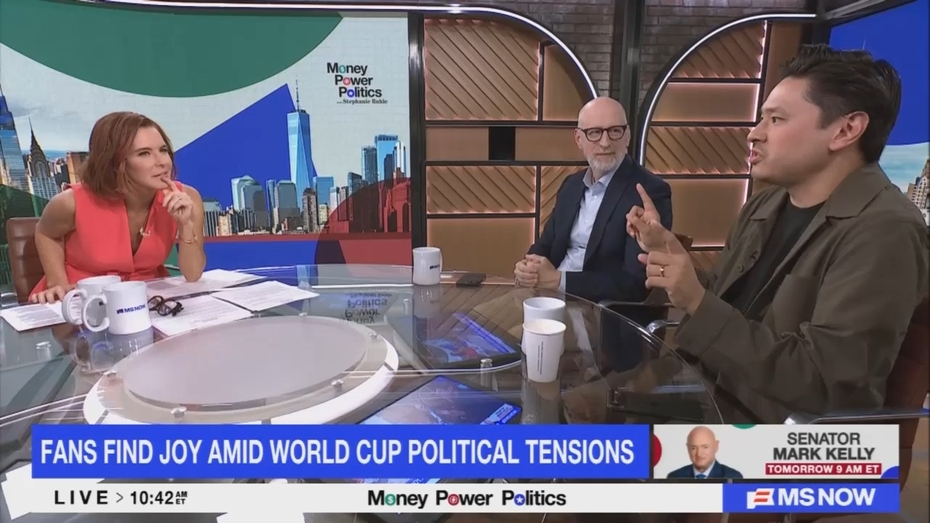
A segment was formed in relation to the World Cup and politics after the Iranian National Team, representing the Islamic Republic of Iran, drew 2-2 with New Zealand in Los Angeles Monday night.
Ruhle then focused on the costs of the World Cup in its American form, as some commentators, media outlets, and foreign relations think-tanks had worried about attendance at games due to high costs for the once-in-four-year event.
She began with the now seeming mandated mention of German X user Freddy, who has chronicled his travels across the southern U.S., showing his glee at the American monuments of SEC football stadiums and Buc-ee's. She called Freddy a “one-off”:
But let's talk about, not just the fan experience, but we have all of these fans from all over the world coming here. And there are some beautiful ones, right? Like people have become obsessed with this guy Freddy from Germany. He's chronicling all of his American experiences, what he's eating, he's loving it, but he's a one-off. Okay?
Tuesday morning on MS NOW, Stephanie Ruhle metioned @FreddyLA7 's travels through America when discussing the World Cup, but she called him a "one-off" and complained about ticket prices and hydration breaks.
— Nick (@nspin310) June 16, 2026
"Is this showing the worst part of America?" pic.twitter.com/D3w1bwwCce
Ruhle then complained about “out-of-reach ticket prices” along with hydration breaks, something which she was likely correct about, in its main reasoning being for more ad breaks.
But then, she asked if the World Cup had shown the “worst part of America”:
Is this showing the worst part of America in terms of, ‘Hey, you want to come, here's a party. I'm the man at the door, pay 50 bucks to get in.’
Torre then called the tournament “the most American of all the World Cups has ever been,” as he decided to complain about the building of a jail in Kansas City that was funded as part of the attempt to lure World Cup games to Kansas City, which it was.
Torre connected the World Cup costs to “the affordability crisis in our country” and called the event only “for people with an expense account."
Ruhle returned to French in a question framed about the coordination, or her feeling, the lack of coordination, between the joint North American host countries on promotion campaigns for the tournament.
French turned the segment into a lesson on Trump relations with Mexico and Canada, before he called sporting ticket buying as an auction where “there are only a fixed pie of seats.”
That is how stadiums work. There is only a set amount of tickets for a 80,000 seat stadium. It's not like everyone can go to games. For an event that only happens once every four years, the tickets will cost more, and there will be less of them to sell.”
An event that has showcased the unknown parts of America, as seen with Freddy and other foreigners with X accounts documenting their U.S. journeys, or the videos seen of Scottish soccer fans enjoying their stay in Boston, Ruhle and Torre’s “worst of America” does not seem to add up.
The transcript is below. Click "expand":
MS NOW’s Money, Power, Politics with Stephanie Ruhle
June 16, 2026
10:42:25 AM Eastern
(...)
STEPHANIE RUHLE: Okay. But let's talk about, not just the fan experience, but we have all of these fans from all over the world coming here. And there are some beautiful ones, right? Like people have become obsessed with this guy Freddy from Germany. He's chronicling all of his American experiences, what he's eating, he's loving it, but he's a one-off. Okay?
Think about what it's like for people, the out-of-reach ticket prices. How much it costs, the transportation, the fact that they now have these extra hydration stations, which just means more commercials. What does this say?
Is this showing the worst part of America in terms of, “hey, you want to come, here's a party. I'm the man at the door, pay 50 bucks to get in.”
PABLO TORRE: It's the most American of all the World Cups has ever been, which may seem obvious, but when you drill down to how that is so - Soccer, by the way, a game of two halves for a zillion years due to these hydration breaks, which are for the health and safety of the players.
RUHLE: That have never existed before.
TORRE: That have never existed before. You have a three-minute break within each half that is fully advertised, resulting in nine. I mean, almost $1 billion of ad revenue. And so the question of you're even changing the game to make money that is deeply American.
Then, of course, we're talking about the affordability crisis in our country, right? I mean, go check out how much it costs to go to these things, because it's not for the American people. It's for people with an expense account.
(...)
10:44:33 AM Eastern
RUHLE: This is the first World Cup hosted by three different countries. What does it say, though, that we've got three different marketing campaigns, three different policies, three different mascots. Like North American unity, we all, at the very least, took for granted, I guess not long ago.
DAVID FRENCH: We took it for granted until the moment when Trump is sworn in and he decides that Canada and Mexico need to be punished for reasons that were unclear to many Americans, and North American unity, which is actually a relatively recent phenomenon, historically speaking, is now off the table again.
And to the point about what the world cup experience, I think it's absolutely true that people across the world. But by the way, this is not a cross-section of the world economy coming to the U.S. These are wealthy people from around coming.
RUHLE: For sure, for sure
FRENCH: But they are seeing something that is becoming, as you said, very American. And that is there are only a fixed pie of seats, and with the secondary markets, it's now essentially an auction. Every sporting event is an auction. And we have an extraordinarily large upper-middle class and wealthy class of Americans. And they gobble up, they win the auction every time. They have the resources.
And so the ability of ordinary Americans to go to sporting events is just falling by the wayside.
(...)