"I am aware that bringing a French structuralist to a cage fight borders on self-parody."
And Beckerman certainly does sound like he is writing parody by trying to explain the perceived meaning behind the UFC 250 fights at the White House on Sunday night by citing a philosopher.
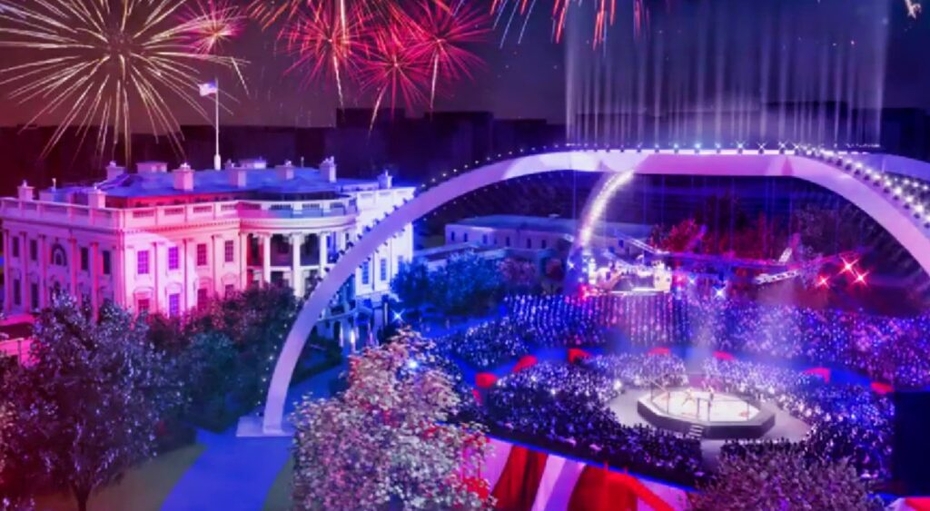
Trump has the same Hollywood instincts, but in the tableau he created last night, he was not using the White House to elevate himself; rather, he was swallowing it whole. The 600-ton star-spangled Claw, which looked like it was about to pick up the White House like a stuffed animal in an arcade game, was meant to convey dominance. So was the scene that preceded the main bout, in which both fighters began their walks to the ring from the Oval Office, looking up at a copy of the Declaration of Independence. Only the president could allow the seat of American power and the founding document to be used this way, and perhaps that was the point.
The French theorist Roland Barthes captured the symbolic meaning of all this perfectly in his 1957 collection, Mythologies, when he described the “spectacle of excess.” In the book, now considered the ur-text of cultural criticism, Barthes picked apart some very taken-for-granted elements of our world, such as soap powders, steak and chips, and Citroëns. But most enduring was his essay on professional wrestling. He saw it, alongside bullfighting and Greek tragedy, as an entertainment that both reduces the human passions to their basic elements—rage, pleasure, and the like—and then blows them up larger than life. These were “great solar spectacles” because they typically took place outside, as if a roof couldn’t contain all that huge feeling. In the plaza de toro, the ancient amphitheater, and—I would add—the UFC White House Octagon, “a light without shadow elaborates an emotion without secrets,” as Barthes writes.
Ah! But did Barthes ever analyze whether "The Flintstones" was a ripoff of "The Honeymooners?"
...Mixed martial arts is something different—more real and more violent. It became legal only in 2016, a few months before Trump won the presidency. But Barthes’s reflections apply here even more than they do to World Wrestling Entertainment.
Wrestling to him is the “draining of interiority in favor of external signs, this exhaustion of content by form.” In other words, all is on the surface, and nuance is banished like a foot slammed into the solar plexus. What struck me about the UFC fights was the anticipation of blood, the waiting for the final moment, when one man would be at the complete mercy of another, and only the referee’s call would stand between the loser and death. “What is thus given to the public is the great spectacle of Suffering, of Defeat, of Justice,” Barthes writes. The emotions are presented with “all the amplification of the tragic masks.” In professional wrestling, the fallen fighter plays his role. In MMA, the shock is real, and so is the fall. But in both cases, the crowd waits for the fighter to produce that face of suffering; “like a primitive Pieta, he allows us to see his face exaggeratedly distorted by an intolerable affliction.”
Do you get the feeling that Beckerman is waaaay overthinking a fun event? Ready for an encore of sheer silliness?
Trump usually operates at this register. Either he is going to annihilate Iran completely—“a whole civilization will die tonight”—or he is announcing that he has just brought everlasting peace to the region, as he did yesterday with a new, though still tenuous, cease-fire agreement. Particularly when it comes to the Iran war, toggling between these extremes has become another kind of exhausting spectacle of excess. He knows no subtlety; for him, as for an MMA fighter, it is either kill or be killed. By staging these fights so close to the seat of executive power, Trump is putting on a show that is also meant to demonstrate what being president means to him. The office might be oval, he is saying, but it is his Octagon.
Beckerman should not be surprised if he ends up the object of much mockery for writing this piece. Even he has enough self-awareness to observe the parody ready silliness of his Libsplaining premise.