Here's how it began:
JONATHAN LEMIRE: I think the theme that's really emerging right now is that even some in the GOP are seeing that Trump is putting his own interests ahead of the party's. Now, that's probably always been the case, but this is the most extreme example, where he's doing nothing to help them ahead of November, trying to turn around the economy, which most voters are gonna judge them on. And instead, he's taking care of himself, his family, and those who've committed violent acts in his name.
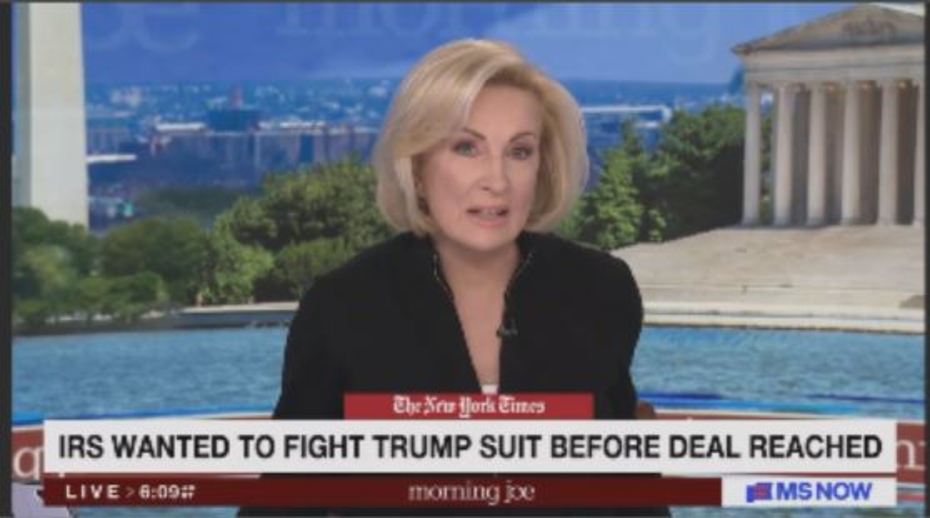
MIKA BRZEZINSKI: The IRS reportedly urged the Justice Department to fight President Trump's lawsuit over leaked tax records, but the administration settled the case anyway. And according to The New York Times, IRS lawyers drafted a twenty-five page memo arguing Trump's lawsuit had major flaws and should be dismissed, but Justice Department lawyers never challenged the case in court. Instead, the administration struck a deal, creating that nearly $1.8 billion dollar anti-weaponization fund.
The Times is probably not your ideal source, since they are the outlet accepting the IRS leaks. But here's where it turns to Reagan:
Mika Turns Reagan 'Shining City' Fan Girl To Trash Trump pic.twitter.com/KlAcUIbXGh
— Mark Finkelstein (@markfinkelstein) May 21, 2026
MIKA: So, Richard Haass, just kind of a big picture about, number one, the importance of American exceptionalism, thinking of Ronald Reagan's 1989 farewell speech, Shining City on the Hill, tall, proud city with free ports that hummed with commerce and creativity and doors open to anyone who will get there.To this, as some would say, corruption, what do we look like, as opposed to the way Ronald Reagan saw this country and the way other presidents tried to create for an example to the world.
RICHARD HAASS: Well, the one word answer, Mika, would be unrecognizable. What we're seeing is the personalization of America, of American government. There used to be clear lines, and the lines don't exist anymore.
Mika's warm embrace of Reagan's "Shining City on a Hill" as a symbol of American exceptionalism stands in stark contrast to how leading liberals treated the exact same rhetoric in real time. He was treated as a scandalous figure, not an honorable one.
Mario Cuomo's 1984 DNC Keynote — one of the most celebrated liberal speeches of the era — directly mocked Reagan:
"The President said that he didn't understand that fear. He said, 'Why, this country is a shining city on a hill.' And the President is right. In many ways we are a shining city on a hill. But the hard truth is that not everyone is sharing in this city's splendor and glory... In fact, Mr. President, this nation is more a 'Tale of Two Cities' than it is just a 'Shining City on a Hill.'... There is despair, Mr. President, in the faces you don't see, in the places you don't visit in your shining city."
Cuomo's address was hailed as eloquent and powerful by Democrats and the liberal media. It framed Reagan's optimism as elitist blindness to poverty and inequality.
And liberals have often treated strong declarations of American exceptionalism as arrogant or dangerous. Here was President Obama in 2009, dismissing American exceptionalism as nothing more than national pride, something common to many countries:
"I believe in American exceptionalism, just as I suspect that the Brits believe in British exceptionalism and the Greeks believe in Greek exceptionalism."
Howard Zinn, the influential left-wing historian, devoted talks and writings to debunking American exceptionalism as a "myth":
"American exceptionalism is the belief that the United States alone has the right... to bring civilization, or democracy, or liberty to the rest of the world, by violence if necessary."
In the 1980s: Reagan's "Shining City" and exceptionalism rhetoric = divisive, out-of-touch, ignoring the "other America."
Today (when useful against Trump): Suddenly, a noble ideal that Trump has made "unrecognizable."
Note: Mika's father, the late Zbigniew Brzezinski, had been Jimmy Carter's National Security Advisor until he lost that prestigious position when Carter was defeated in 1980 by... Ronald Reagan. So hard to imagine that Mika has been much of a Reagan fan — until now.
Here's the transcript.
MS NOW
Morning Joe
5/21/26
6:08 am EDTJONATHAN LEMIRE: He was gonna seek thirty million dollars from this fund. Now we—I have no idea if that's gonna happen, but that shows you the door that's been opened here, that people see this as an opportunity.
And again, you know, Mika, it is a moment where there are Republicans who are willing to say, "Ah, we're not really sure we're for this." But to the—I think the theme that's really emerging right now is that even some in the GOP are seeing that Trump is putting his own interests ahead of the party's. Now, that's probably always been the case, but this is the most extreme example, where he's doing nothing to help them ahead of November, trying to turn around the economy, which most voters are gonna judge them on. And instead, he's taking care of himself, his family, and those who've committed violent acts in his name.
MIKA BRZEZINSKI: The IRS reportedly urged the Justice Department to fight President Trump's lawsuit over leaked tax records, but the administration settled the case anyway. And according to The New York Times, IRS lawyers drafted a twenty-five page memo arguing Trump's lawsuit had major flaws and should be dismissed, but Justice Department lawyers never challenged the case in court. Instead, the administration struck a deal, creating that nearly one point eight billion dollar anti-weaponization fund. The Justice Department hasn't explained why it chose to settle.
So, Richard Haass, just kind of a big picture about, number one, the importance of American exceptionalism, thinking of Ronald Reagan's 1989 farewell speech, Shining City on the Hill, tall, proud city with free ports that hummed with commerce and creativity and doors open to anyone who will get there. We're gonna get to some ICE and immigration stories a little later in the show, but to this, as some would say, corruption, what do we look like, as opposed to the way Ronald Reagan saw this country and the way other—the president tried to create for an example to the world.
RICHARD HAASS: Well, the one word answer, Mika, would be unrecognizable. What we're seeing is the personalization of America, of American government. There used to be clear lines, and the lines don't exist anymore.