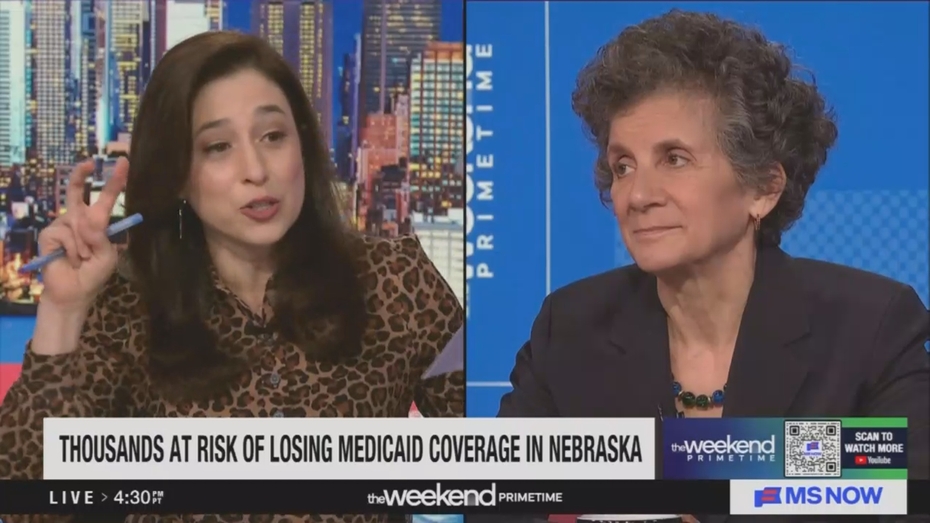
Equally predictable was the "expert" MS NOW chose: NYU professor Sherry Glied — a former top Obama HHS official deeply involved in rolling out Obamacare. Glied spent most of the segment warning about coverage losses and hardship.
Only toward the end did Glied let the liberal cat out of the bag: “It’s not a great idea, in my opinion, to have work requirements for anything.”
That said it all. Glied rejects the very concept that able-bodied adults receiving taxpayer-funded assistance — of any sort — should work, train, or volunteer in return.
WATCH:
— Mark Finkelstein (@markfinkelstein) May 4, 2026
MS NOW's Medicaid 'Expert' Opposes Work Requirements 'For Anything!' pic.twitter.com/nmcrFkWLnl
Co-host Catherine Rampell kicked things off by claiming Nebraska’s move would “strip" coverage from around twenty-five thousand residents.
RAMPELL: I think we actually have a chart showing, this is from KFF [formerly Kaiser Family Foundation]. The vast majority of people who are on Medicaid… are either already working or have one of these exemptions. 44% are working full time. Another 20% are working part time. It’s a very tiny fraction of Medicaid recipients who are not working and would be, in theory, supposed to be the [air quotes--see screencap] undeserving — the undeserving poor as opposed to the deserving poor.
Notice what wasn’t mentioned: the actual percentage—8%—of those in the “not working due to retirement, inability to find work, or other reason” category. And viewers weren’t told that self-reporting “retirement” for people under 65 and “inability to find work” are not valid exemptions under Nebraska’s policy or the federal rules. Those categories are exactly whom the work requirements are designed to reach.
Nationally, that 8% represents over two million people, and countless billions in undeserved Medicaid payments.
Meanwhile, improper Medicaid spending has exploded, with federal improper payments hitting $37.39 billion in FY 2025. Fraud is rampant, especially on the provider side. California’s Medi-Cal has seen huge hospice and home health scams — with one $267 million hospice ring alone, using stolen identities. Work requirements would shrink the pool of enrollees available for these volume-billing schemes. Fewer people on the rolls means fewer phony claims.
Past experiments like Arkansas's did have paperwork problems. But the solution is smarter design (automatic data checks, clear exemptions), not Glied’s absolutist “no work for anything” position.
No surprises here. MS NOW shopped for an expert and found one wired to oppose these reforms from the jump.
Taxpayers footing the bill for an ever-growing, fraud-plagued entitlement deserve better than this kind of one-sided alarmism--but don't expect it from MS NOW.
Here's the transcript.
MS NOW
The Weekend: Primetime
5/3/26
7:28 pm EDTCATHERINE RAMPELL: States across the country have just eight months left until they need to implement the Medicaid work requirements mandated by President Trump’s so-called Big Beautiful Bill. But one Republican state decided to eagerly beat that deadline. On Friday, Nebraska became the first state to enact Medicaid work requirements. The move is expected to strip coverage from around twenty-five thousand residents who qualified for the program under the Affordable Care Act’s Medicaid expansion. An estimated seventy-two thousand Nebraskans will be subject to the policy, which applies to able-bodied adults ages nineteen to sixty-four.
Joining us now is Sherry Glied, professor of public service at NYU, and former Obama administration health official. Sherry, thanks so much for joining us. Could you talk to us a little bit about what the practical effects may be of these work requirements in Nebraska?
SHERRY GLIED: So, the way the work requirements are gonna work, or are supposed to work, is that people who are eligible for Medicaid on the basis of their incomes will have to prove that they’ve worked enough over the past month, two months, three months, depending on how a state sets it up, in order to retain their Medicaid coverage. They’ll have to give proof that they’ve either worked eighty hours in the past month, or that they’ve met an earnings threshold, or that they meet one of a host of different exemptions.
The consequence of this actually is gonna be that there’s a lot of paperwork that people are gonna have to do over and over and over again in order to keep their Medicaid.
RAMPELL: Yeah, I think we actually have a chart showing, this is from KFF, showing that most people who are on — the vast majority of people who are on Medicaid — I don’t know if you can read this — are either already working or have one of these exemptions.
So, you know, forty-four percent are working full time, uh, another twenty percent are working part time, and then the most of the remainder are people who have one of these qualifying exemptions. They’re in school, they have illness or disability, they’re caregiving, et cetera.
Um, it’s a very tiny fraction of Medicaid recipients who are not working and would be, in theory, are supposed to be the [air quotes] undeserving — uh, the undeserving poor as opposed to the deserving poor.
. . .
You are a trained economist, right?
GLIED: Right.
RAMPELL: Uh, is there any mechanism by which, like, dangling the prospect of taking away someone’s healthcare or giving them healthcare will actually encourage them to work.
GLIED: It is really hard to imagine that there are a lot of people who are only on Medicaid, who are not working because they are on Medicaid. It’s just such an odd thing to think about. It’s Medicaid, you don’t even need it unless you’re sick, right?
Like, it's not like, it’s not a great idea, in my opinion, to have work requirements for anything. But in the case of health insurance, it’s a particularly odd rationale to imagine that people are staying away from work so that they can have their health insurance.
RAMPELL: And some people need their medications in order to work.
GLIED: Absolutely.