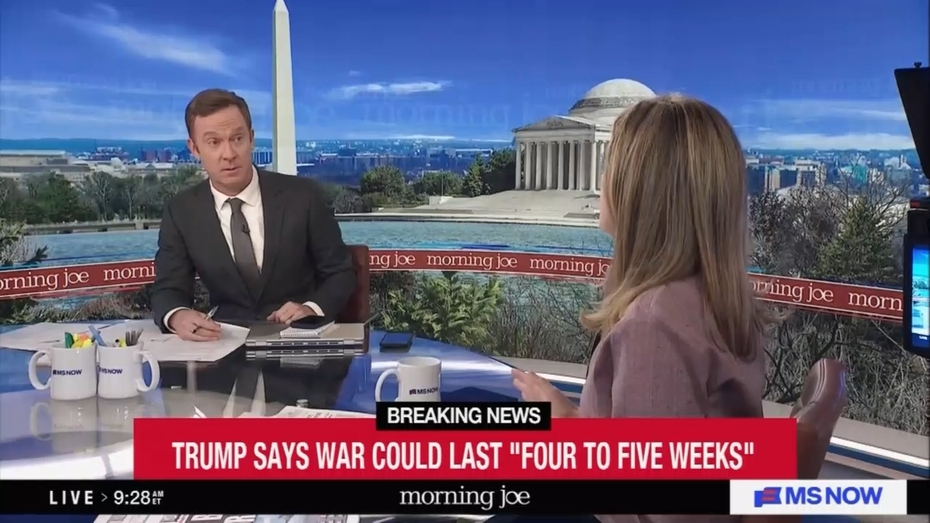
The Morning Joe hosts and panelists also had a special focus on how the actions in Iran were supposedly not “America First,” even though the President has talked about Iran not being allowed to have a nuclear weapon since the 2016 election.
In his line of questioning to a panel comprised of Jordan, John Heilleman, and noted Iran expert Al Sharpton, Lemire had an overwhelming focus on how Trump’s approval would fall in the case of more American troop deaths and a prolonged war:
I think the consensus, of the people I've talked to, is if this does just last a few days or a week or so, it's something that the president gets through. But if this does extend three, four, six weeks and the American death toll really accelerates, this is not just a defining moment for this president, but a real problem for his party in a midterm election year.
Panelist John Heilemann agreed with Lemire’s assertion but also added, "President Trump's political strength over the course of his time in public life, how much of that has been rooted in his - the consistency of his posture about no more endless wars.”
Lemire then turned to Jordan to respond to Hegseth’s press conference and his reluctance to share classified war plans with the media. She exclaimed how nobody knows what the war is about:
Well, beside his - behind his condescending demeanor, that aside, notice how he says constantly “mission,” “clear objectives”. He repeatedly says, “we have a mission,” “We have objections” - what are they? He can't put them out there. That is the whole problem here. We don't know what this war is about.
(...)
No one has any idea what this war is about and it is a problem because they don't have a strategy and they don't have a plan. And you look at the politics of this, it's only going to get worse with time if this is how it's starting. (...)
Jordan comments differed from the media’s obsession over Signal-gate where there was an outcry of sharing of war plans in an encrypted chat. With their logic, maybe the Department of War should just publish all their classified war plans now.
Once again, Lemire continued his assertion of more troops being killed, almost giddy when finishing Jordan’s thoughts.
JORDAN: Only one out of four Americans , today, supports this war. It's only going to get worse.
LEMIRE: How about if more Americans are killed in it (...)
Lemire seemed to almost root for more military deaths in order for there to be a lower Trump approval ratings.
Paired with the rest of the panel, there seemed to be a constant denial of the reasoning for a fight with a terroristic Iranian regime, paired with a want of the situation to go out of the control to finally “get Trump.”
The transcript is below. Click "expand":
MS NOW’s Morning Joe
March 2, 2026
9:23:20 AM Eastern
JONATHAN LEMIRE: So, let's get into some of the politics of this now. Joining us, MS NOW national affairs analyst John Heilemann, he is a partner and chief political columnist at Puck. The host of PoliticsNation on MS NOW, the Reverend Al Sharpton is here, he, of course, also the president of the National Action Network. And co-host of The Weekend: Primetime here on MS NOW, Elise Jordan. A great group, our thanks to all of you for being here.
John Heilemann, I'll start with you on the politics of this. Mika just went through - there are a few, the usual cast of characters on - among Republicans who are, at least for now, publicly objecting to this war, although many more have shared reservations privately. We're also seeing a lot of heavy hitters in MAGA universe, whether it's Tucker Carlson or Steve Bannon, others expressed reservations about this conflict, saying this is not the America First we thought we were getting with this president.
I think the consensus, of the people I've talked to, is if this does just last a few days or a week or so, it's something that the president gets through. But if this does extend three, four, six weeks and the American death toll really accelerates, this is not just a defining moment for this president, but a real problem for his party in a midterm election year.
(...)
9:25:33 AM Eastern
JOHN HEILEMANN: I do think that there's a tendency on the part of a lot of analysts to sort of talk about the resistance to this that we're seeing in these small corners of the MAGA sphere. Whether it's the online corners of that, the Tucker Carlson's of the world, or whether it's Thomas Massie and Rand Paul, and sort of try to isolate that and sort of say, well, that's part of Trump's kind of online base or the MAGA, the America first quadrant of the of the Republican base.
I just - I think it understates the degree to which President Trump's political strength over the course of his time in public life, how much of that has been rooted in his - the consistency of his posture about no more endless wars. And to your point, Jonathan, I think, you know, Venezuela shows that Donald Trump was able to get through that without incurring a lot of political damage because it was quick and seemed to be painless, and was deemed a success and didn't have a lot of high body count.
I totally agree, and I think that the depth of the problem that he would face would be enormous if this incursion, if this conflict lasts any degree of time and we suffer any degree of casualties going forward, I think the amount of political impact it would have on him and on the Republican party would be hard to overstate.
LEMIRE: Completely agree with that.
(...)
9:28:30 AM Eastern
ELISE JORDAN: Well, beside his - behind his condescending demeanor, that aside, notice how he says constantly “mission,” “clear objectives”. He repeatedly says, “we have a mission,” “We have objections” - what are they? He can't put them out there. That is the whole problem here. We don't know what this war is about.
Donald Trump said, from the get go, it was about encouraging the Iranian people to stand up, regime change. Then you hear through so many different interviews that he does so many different options. This could go a month, it could be a couple of days, I don't know, maybe I'll negotiate. No one has any idea what this war is about and it is a problem because they don't have a strategy and they don't have a plan. And you look at the politics of this, it's only going to get worse with time if this is how it's starting. It's exactly what the Republican base doesn't want, the MAGA base. But more than that, the American people. Only one out of four Americans, today, supports this war. It's only going to get worse.
LEMIRE: How about if more Americans are killed in it. And, Rev., certainly a commander in chief is supposed to outline to the American people, to the military in harm's way, why we're doing this. What are our objectives? The talk of the Iraq war, your candidacy for president back in 2004 came amid some of the blowback to that conflict. And eventually Bush was reelected then, eventually it would consume his administration. What parallels do you see here? This seems like a lot of political risks for President Trump at a moment where, to Elise's point, most of the public doesn't want this.
AL SHARPTON: When I ran for president in 2004, it was around saying that we didn't believe there were weapons of mass destruction that Bush was engaged in, that was the campaign. He ended up winning, John Kerry was defeated, but that was the issue. So here we are some 22 years later where we don't know why we're there. There are no apparent threats, direct threats of a nuclear attack to the United States. We don't know who - when the president saluted people for marching in the streets in Iran and all, and no one’s supporting the supreme leader, Khamenei, but no one's talking about who is the opposition, who are we dealing with now. And then, if I was running tomorrow in Arkansas or Texas or in North Carolina primaries, I'd be concerned with the escalating oil prices. How does that affect my campaign? Because people may be concerned now more about my gas is going to go up than some of the issues I've been campaigning on. So, there's a lot of uncertainty here that Trump has put into this whole process that could be impacted in various ways.
(...)