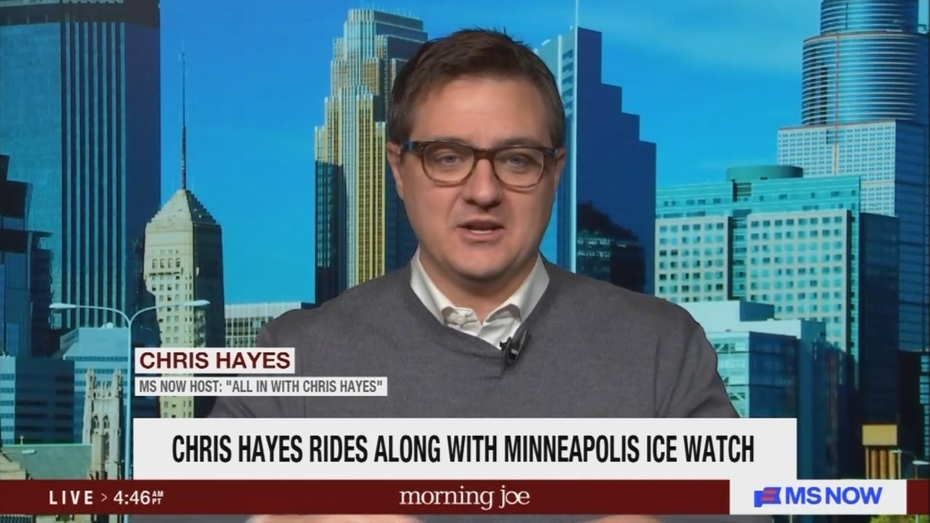
Coming off a ride along with members of leftist activist group ICE Watch, a group that calls for "resisting against ICE,” Hayes praised the unity among protestors:
“What I have been so struck by, a few things. One, the unity that people feel. I mean, people genuinely feel under siege.
(...)
And that sense of siege has created this incredibly steely sense of unity, along with a lot of grief and rage after two people were shot and killed by agents of their own government.”
Hayes then talked about the structure of the resistance group, comparing it to the groups seen in the Civil Rights Movement:
If you go and read Taylor Branch's Pulitzer Prize winning chronicle of the Civil Rights Era, particularly the first one, Parting the Waters, there's chapters about the Montgomery Bus Boycott. And everyone sort of learns the Rosa Parks part of it, and then there's the boycott, and then there's a victory. That boycott went for over a year, if I'm not mistaken. And all that year it was all logistics, like, how are people going to get rides? Who's giving rides to who? Like real sort of granular stuff about how to make this work. And that's what you're seeing here is this remarkable, voluntary, ad hoc, but highly organized civic infrastructure grow up, born purely out of like a desperate desire to protect their neighbors.”
In response to host Willie Geist’s question that scoffed at the idea of paid agitators being involved in Minneapolis protests, Hayes continued with his praise of ICE resistance groups, with comparisons to parent sports groups who prepare oranges for halftimes of kids soccer games:
He's like, “they have hand warmers and snacks.” It's like, right, like every single— every single, you know, travel soccer game has that. And in some senses, you know, if you're a parent, you are on what, five to ten WhatsApp groups for different activities: travel basketball, your classes.”
What's happened here is that all of those WhatsApp groups that were - that got created for that have become Signal groups about how they can make sure that ICE doesn't kidnap a teacher at their school, or a kid at their school. So all of the civic infrastructure that existed, again, a lot of this has been like parents and PTAs for that. Like, who's bringing snacks to this weekend's travel soccer game is now: how do we make sure that this family can get groceries because they're afraid to leave the house because they might get snatched on the street.
Hayes tried to find whatever ridiculous comparison stuck, going from Civil Rights protestors to soccer moms planning snacks for their kids games in his attempt to validate the actions of organized, anti-ICE groups.
Hayes' validation should be taken with a huge grain of salt, especially after his previous defamatory statements about ICE and a Georgia doctor he and other MS NOW personalities dubbed as “the uterus collector,” which led to an undisclosed monetary settlement.
The transcript is below. Click to expand:
MS NOW’s Morning Joe
January 28, 2026
7:43:07 AM Eastern
MIKA BRZEZINSKI: That's the host of MS NOW’s All In with Chris Hayes. Chris Hayes, doing a ride along with two members of ICE Watch in Minneapolis, describing to him how federal officers typically treat them when they arrive on the scene. And Chris joins us now live from Minneapolis. His New York Times bestseller titled The Sirens’ Call: How Attention Became the World’s Most Endangered Resource is now available in paperback. We'll get to that in a moment and how it really actually connects here. But Chris, first, what are you seeing and hearing on the ground? More from your interviews with people there?
CHRIS HAYES: What I have been so struck by, a few things. One, the unity that people feel. I mean, people genuinely feel under siege. Just talking to folks, like, it's hard, I think, to grasp just how ubiquitous the presence of these agents have been, how everyone is just one person, either directly impacted or one person away from it, that there were agents at their kids’ schools, that their favorite supermarket had agents there, like, people have been encountering it. And that sense of siege has created this incredibly steely sense of unity, along with a lot of grief and rage after two people were shot and killed by agents of their own government.
The other thing that I think is really interesting, and you got a little bit in that ride along yesterday, is the level of civic infrastructure that has been built on the fly by people here. I mean, we're talking tens of thousands, probably 100,000 people have gone through these upstander trainings. There are people doing all kinds of different things, from doctors giving medical care to people getting groceries, to folks locking arms around schools.
You know, if you go and read Taylor Branch's Pulitzer Prize winning chronicle of the Civil Rights Era, particularly the first one, Parting the Waters, there's chapters about the Montgomery Bus Boycott. And everyone sort of learns the Rosa Parks part of it, and then there's the boycott, and then there's a victory. That boycott went for over a year, if I'm not mistaken. And all that year it was all logistics, like, how are people going to get rides? Who's giving rides to who? Like real sort of granular stuff about how to make this work. And that's what you're seeing here is this remarkable, voluntary, ad hoc, but highly organized civic infrastructure grow up, born purely out of like a desperate desire to protect their neighbors.
WILLIE GEIST: Chris, good morning, it's so great to see you. I just - I think all of us in the country has been struck by the resilience of the people in Minneapolis, which, as you say, they've been through a lot in these last, let's call it, six years or so since the murder of George Floyd as well. But I think you make a really interesting point about the infrastructure. We hear again yesterday from President Trump saying, “they're paid agitators, they're organized.”
Well, there's a difference between being organized and being an outside agitator or mercenary of some kind. These are people of these neighborhoods who don't like what they're seeing in their communities and are out there doing something about it, even, it turns out, at the risk of their own lives. So where are they finding that resilience to keep coming out?
HAYES: I think one of - part of it is just people feel attacked and there's a unity and resilience that comes from that. But on the organizing thing, it's so funny, this idea of, like, paid agitators, you know, there's some right-wing influencer who was like, you know, he had a picture of a, you know, table at some training. He's like, “they have hand warmers and snacks.” It's like, right, like every single— every single, you know, travel soccer game has that. And in some senses, you know, if you're a parent, you are on what, five to ten WhatsApp groups for different activities: travel basketball, your classes.
What's happened here is that all of those WhatsApp groups that were - that got created for that have become Signal groups about how they can make sure that ICE doesn't kidnap a teacher at their school, or a kid at their school. So all of the civic infrastructure that existed, again, a lot of this has been like parents and PTAs for that. Like, who's bringing snacks to this weekend's travel soccer game is now: how do we make sure that this family can get groceries because they're afraid to leave the house because they might get snatched on the street. And that threat, I just got to emphasize this, it's real. I mean, there was at the peak here and we don't know the numbers right now, something like 15 percent of all ICE agents in the country were in this – in the Twin Cities. There's only a few hundred thousand people here. I mean, this was happening everywhere people were going.