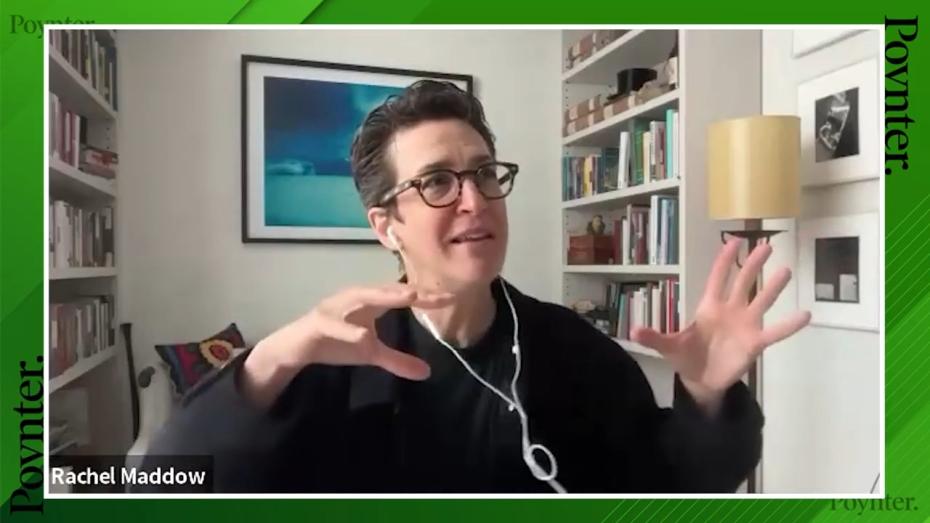
On The Poynter Report Podcast, produced by the Poynter Institute, which is described as a journalism school that also runs Politifact, MS NOW host Rachel Maddow was invited on the journalism podcast to discuss the Trump White House barring CNN, MS NOW, and Politico from the White House.
After discussion of the ban, podcast host Tom Jones asked Maddow who the media let Trump happen, to which Maddow gave a long answer that, in part, claimed there was a “chronic infection” of fascism in this country that “bubbles up every generation or so,” which “tries to eat the right-wing party in this country and turn it into a populist fascist uprising that will overthrow the constitutional republic.”
Still in her opening answer to a question about the White House bans, she said, “I don't care what's in his heart of hearts. I don't care what's barreling around in his empty little soul. I only care about what he does. And what he does is abhorrent, but it's also very like typical textbook authoritarian leader-style stuff.”
After Rachel Maddow was asked how the media allowed Trump to happen on the Poynter Institute’s journalism podcast, she went into a long answer that included her saying the Oil industry ”would prefer stable corrupt dictatorships” and claimed there is a “recurring problem on the… pic.twitter.com/WoIskVCh0C
— Nick (@nspin310) September 28, 2026
Maddow continued with reference to the former President of Hungary, “I mean, he's just going faster than Orban, you know? That's all. That's the only difference.” She added, “These guys really only have one play when it comes to the press. They don't, they don't iterate. They don't, you know, they don't innovate. They don't, they don't syncopate. They all just do the exact same thing. And this is, you know, this is a blonde Mussolini outfit.”
Jones then asked, “But I guess sort of the question is, how did we allow this to happen? Did we fail? When I say we, I mean, mainstream media. Did we fail in this decade?”
Maddow used the moment to talk about the books she was written on the Trump presidency and cited ideas like “building up the unitary executive”: “Like, okay, the building up the unitary executive. Like that's not something you want to do in a country if you could see into the future and see that you've got an authoritarian-minded populist leader who's got his designs on the White House, but yet we did it.“
She then hit the Supreme Court and the oil and gas industry, said, “If you let them get free rein in politics, particularly if the Supreme Court greenlights unlimited dark money into politics, it is their preference as an industry to not have too much turnover, to not have too much democratic accountability in any government that they're dealing with, they would prefer stable corrupt dictatorships.”
Then, Maddow claimed “fascism” was a "chronic infection” in the country:
Then I wrote a book about how America has had a recurring problem on the right, even quite adjacent to mainstream right-wing electoral politics, where we've got fascism like essentially chronic infection in this country, and it bubbles up every generation or so in a more or less powerful way, essentially trying to eat the right-wing party in this country and turn it into a populist fascist uprising that will overthrow the constitutional republic.
But after her fascism fearmongering, Maddow concluded, “I mean, it's bad news because I do think this has been a long time coming, but I also think that some of the ways that Americans before us have fought these things off in the past, it gives us good lessons learned in terms of how to fight it now.”
Given how the podcast feared for journalism, it was a bit of a shock for claims of fascism to go without pushback. In reality, it was less surprising given the home page of the Poynter website promotes an event that will honor fired 60 Minutes correspondent Scott Pelley.
The transcript is below. Click "expand":
The Poynter Report Podcast
September 28, 2026
Timestamp: 08:29-12:13
(...)
RACHEL MADDOW: I don't care what's in his heart of hearts. I don't care what's barreling around in his empty little soul. I only care about what he does. And what he does is abhorrent, but it's also very like typical textbook authoritarian leader style stuff.
I mean, he's just going faster than Orban, you know? That's all. That's the only difference. These guys really only have one play when it comes to the press. They don't, they don't iterate. They don't, you know, they don't innovate. They don't, they don't syncopate. They all just do the exact same thing. And this is, you know, this is, this is a blonde Mussolini outfit.
Like I just, I think what is interesting about this moment is not necessarily what he's doing, but how the industry is reacting, and ultimately how the public will react. I do think it's sort of an open question as to whether he'll get the same political bang for his buck going after the press the way he used to. I think he'll get some, but I'm not sure he'll get as much as he used to.
TOM JONES: Yeah, that leads me to what I wanted to ask you about. Like, you've been on the air since well before he came down the escalator to run for president for the first time.
Do you ever pause and say like, how did we get here? Because it wasn't overnight, I mean, it was, it’s almost like this slow, tortoise crawl to where we've gotten to. And it's, I wonder, as the media, and I realize media is a broad, a really broad term. It involves a lot of things. But I guess sort of the question is, how did we allow this to happen? Did we fail?
When I say we, I mean, mainstream media. Did we fail in this decade?
MADDOW: You know, I realized kind of. I don't know, somewhere in the middle of Trump's first term. Well, I guess that's not true.
I realized sometime around him getting back into office for a second term that I had sort of accidentally written a series of books about how this happened. [Laughter] Like first book that I wrote was about, basically, the decision to put all national security related power in the Executive and Congress giving that up because they found it politically inconvenient. Like, okay, the building up the unitary executive. Like that's not something you want to do is a country if you could see into the future and see that you've got an authoritarian-minded populist leader who's got his designs on the White House, but yet we did it.
Then I wrote another book on the oil and gas industry and how that industry, among others, but that industry particularly, if you let them get free rein in politics, particularly if the Supreme Court greenlights unlimited dark money into politics, it is their preference as an industry to not have too much turnover, to not have too much democratic accountability in any government that they're dealing with, they would prefer stable corrupt dictatorships. Okay? [Laughter]
Then I wrote a book about how America has had a recurring problem on the right, even quite adjacent to mainstream right-wing electoral politics, where we've got fascism like essentially chronic infection in this country, and it bubbles up every generation or so in a more or less powerful way, essentially trying to eat the right-wing party in this country and turn it into a populist fascist uprising that will overthrow the constitutional republic.
So, [Laughter] I've been accidentally writing books all of this time about all of the ways we structurally made ourselves profoundly unsuited toward fending this off in this moment. I mean, it's bad news because I do think this has been a long time coming, but I also think that some of the ways that Americans before us have fought these things off in the past, it gives us good lessons learned in terms of how to fight it now.
(...)