On Monday’s Morning Joe, the show promoted a recent New York Times piece that fretted over Freedom of Speech in President Trump’s second term. Host Jonathan Lemire described it as “Trump’s attempts to stifle freedom of speech and of the press,” which he called “deeply worrisome.” Lemire and book author and former Slate editor Jacob Weisberg later complained that former Republican President George W. Bush had not become an anti-Trump activist like former Representative Liz Cheney.
Lemire began, “The New York Times is out with a comprehensive new analysis about President Trump's attempts to stifle the freedom of speech and of the press during his second term. Doing so by deploying federal agencies, executive orders, and personal lawsuits against journalists, media corporations, and critics.”
He then read through much of the piece, which included an excerpt saying America’s press freedom was “just below Botswana,” before he opined, “We could add to that the Pentagon has thrown out reporters from the building there. The White House hijacked the press corps and the pool in the building. The assaults go on and on. Deeply worrisome.”
Monday’s Morning Joe echoed a New York Times piece that feared for Freedom of Speech during Trump’s Second Term, which Jonathan Lemire introduced as a "comprehensive new analysis about President Trump's attempts to stifle the Freedom of Speech and of the press during his second… pic.twitter.com/154DR6OyMO
— Nick (@nspin310) September 14, 2026
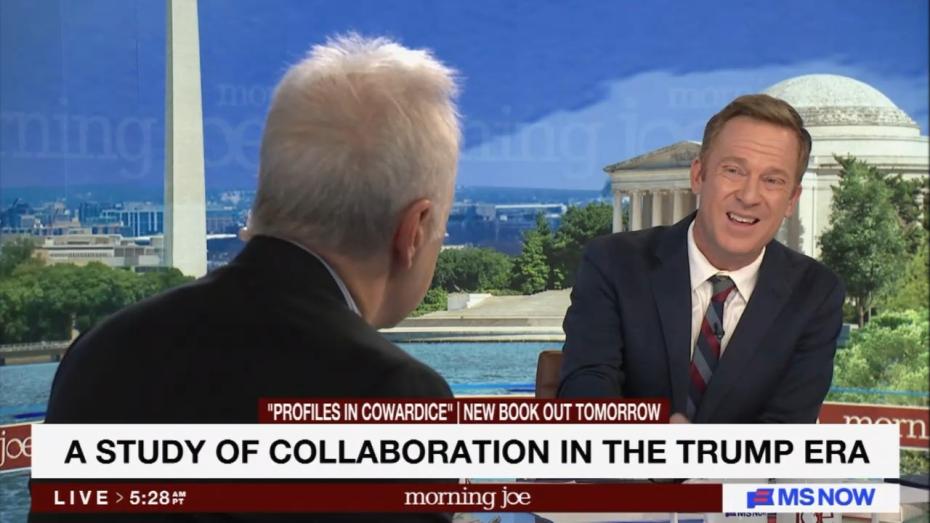
Lemire continued and introduced Weisberg, who was there to promote a new book titled Profiles in Cowardice, where he shows displeasure with business and tech leaders for not becoming anti-Trump activists.
After Weisberg gave brief initial details on his book, Lemire brought up former President Bush and wondered why he did not actively become anti-Trump:
But I want to highlight one that was excerpted in The New Yorker, I believe, in the last week or so, and I've always been struck by this. George W. Bush, I feel like might have been the one Republican had he spoken out against Trump at certain junctures in the Trump era, particularly post January 6th, pre-Trump comeback, where his voice would have had enough weight to maybe convince others in the Republican party to say, ‘You know what? Maybe we shouldn't go back on this Trump thing.’ But yet Bush stayed silent.
Lemire then complained that former President George W. Bush had not become an anti-Trump activist.
Jacob Weisberg, who has a book titled “Profiles in Cowardice” that complains about figures like Jeff Bezos not becoming anti-Trump activists, was upset Bush did not follow the lead… https://t.co/Oyy23kQBhM pic.twitter.com/vxa6RxgeMF— Nick (@nspin310) September 14, 2026
Weisberg responded with agreement and was upset he did not act like the Cheneys:
I think it could have made a difference in 2016 and again in 2024. If he had said, this is not who we are as a country, there's still a non-MAGA wing of the Republican Party. And there are a lot of independents for whom I think that would have been meaningful. And you know who did it? Dick Cheney and Liz Cheney. In 2024, they said, ‘This is too important. We're voting for Kamala Harris, who we disagree with about everything, because this is a question about democracy.'
Lemire then mocked Bush: “And you point out he's entirely too busy painting as someone close to him put it to me once, he doesn't want to get booed next time he goes into a Dallas steakhouse because he didn't want to alienate other Republicans. So, he has stayed silent.”
The pair then turned to talk about business industry leaders, like Amazon founder and Washington Post owner Jeff Bezos, and were surprised they too did not become full-on anti-Trump activists during the second term:
Weisberg called Bezos the “perfect example” of his Profiles in Cowardice book “because, in Trump One, he was an exemplary owner of the Washington Post. He stood up to Trump in every way.”
But now, he said, in “Trump Two, he's on bended knee at Mar-a-Lago, making a deal to pay $40 million for the Melania documentary, which bears no relation to anything Amazon had ever paid for a documentary before. It's corrupt, and it was such a such a reversal that I think it creates a kind of mystery. Why so different?”
In her complaints over Bush, Lemire and Weisberg seemed to not understand that Bush had stuck to his conservative principles rather than contradict them by endorsing liberal candidates for office, unlike others, including the Cheneys.
The transcript is below. Click "Expand":
MS NOW’s Morning Joe
September 14, 2026
8:25:42 AM Eastern
JONATHAN LEMIRE: The New York Times is out with a comprehensive new analysis about President Trump's attempts to stifle the freedom of speech and of the press during his second term. Doing so by deploying federal agencies, executive orders and personal lawsuits against journalists, media corporations, and critics.
Times journalists Maggie Haberman and Jim Rutenberg detail several examples, including the Department of Justice's failed attempt to subpoena New York Times reporters, an FBI raid on the home of a Washington Post reporter, Trump's lawsuits against ABC and CBS, and FCC chair Brendan Carr's threats against broadcast networks.
The piece states: “Almost 20 months into Trump's second term, his long-running media clashes have grown into a sweeping campaign to control speech in America that stands out for applying so many levers so fast all at once.”
The nonprofit group Freedom of the Press Foundation told The Times. The Trump Administration's moves, quote, “have certainly risen to the level where they're kind of off the charts. That's because government because government efforts to subpoena journalists and chill their reporting through threats are at the highest level since the foundation started tracking such incidents back in 2017.”
“The U.S. now ranks 64th in Reporters Without Borders' Press Freedom Index, its lowest since 2002, just above Panama and just below Botswana.”
We could add to that the Pentagon has thrown out reporters from the building there. The White House hijacked the press corps and the pool in the building. The assaults go on and on. Deeply worrisome.
Joining us now, the author, Jacob Weisberg. He has a new book out tomorrow titled Profiles in Cowardice: A Study of Collaboration in the Trump Era. MS NOW contributors Pablo Torre and Huma Abedin are with us as well. So, Jacob, congrats on the book. Timely to be sure. Connected to that previous New York Times story here.
JACOB WEISBERG: Well, yes, indeed. We've never had a sitting president who filed personal lawsuits against journalists, let alone totally spurious suits based on nothing. Among others, he sued my book publisher, Penguin Random House, for publishing a book by New York Times reporters. The suit has been thrown out once he's back in court with it again. There's so much of this going on that it's impossible even to keep track of it.
LEMIRE: Yeah, no, I agree. And your book details some of the media figures, like Jeff Bezos, who owns Washington Post, you know, Megyn Kelly and the like. We can get to more of them in a moment. But I want to highlight one that was excerpted in the New Yorker, I believe, in the last week or so, and I've always been struck by this. George W. Bush, I feel like might have been the one Republican had he spoken out against Trump at certain junctures in the Trump era, particularly post January 6th, pre-Trump comeback, where his voice would have had enough weight to maybe convince others in the Republican party to say, ‘You know what? Maybe we shouldn't go back on this Trump thing.’ But yet Bush stayed silent.
WEISBERG: John, I agree with you. I think it could have made a difference. I think it could have made a difference in 2016 and again in 2024. If he had said, this is not who we are as a country, there's still a non-MAGA wing of the Republican Party. And there are a lot of independents for whom I think that would have been meaningful. And you know who did it? Dick Cheney and Liz Cheney. In 2024, they said, this is too important. We're voting for Kamala Harris, who we disagree with about everything, because this is a question about democracy.
LEMIRE: Yeah. And you point out he's entirely too busy painting as someone close to him put it to me once, he doesn't want to get booed next time he goes into a Dallas steakhouse because he didn't want to alienate other Republicans. So, he has stayed silent.
So, let's talk about some of the other titans of industry here that you have written about. And it was so striking those first months of the Trump term, the people who bent the knee, who probably didn't have to, including heads of law firms and big, powerful CEOs.
WEISBERG: Yeah, I mean, it was it was so notable with the tech CEOs. I have a chapter about Jeff Bezos and a chapter about Steve Schwarzman, the co-founder of Blackstone. Bezos is sort of the perfect example because, in Trump One, he was an exemplary owner of the Washington Post. He stood up to Trump in every way. Trump took away a $10 billion contract from Amazon to punish Bezos for the coverage of the Washington Post. And Bezos said all the right things and did all the right things.
Trump Two he's on bended knee at Mar-A-Lago, making a deal to pay $40 million for the Melania documentary, which bears no relation to anything Amazon had ever paid for a documentary before. It's corrupt and it was such a such a reversal that I think it creates a kind of mystery. Why so different? And why, more generally, did the guardrails hold in Trump One and have not held in Trump Two?
(...)