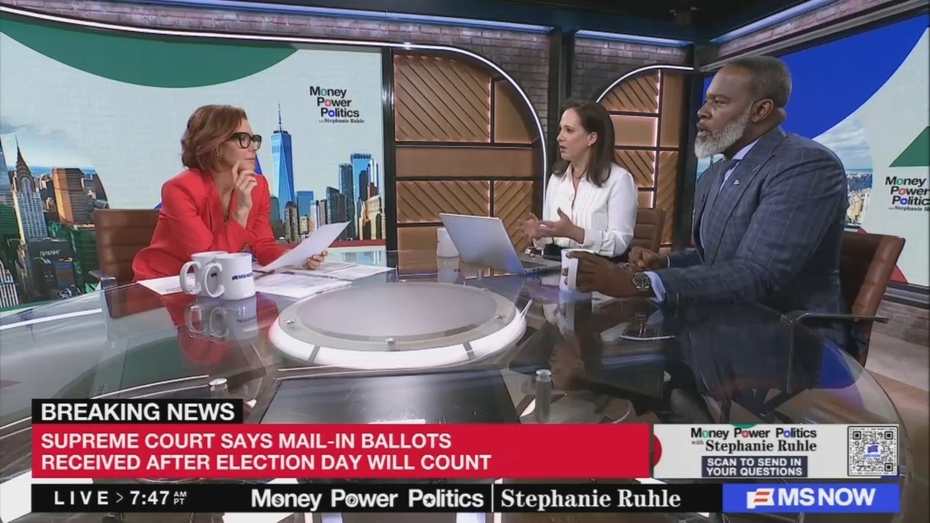
But later in the hour, after the court ruled in Trump v. Slaughter, which allowed the President to fire an FTC commissioner, the tone shifted, as Ruhle said the day “seemed much darker” than it was after the ballot ruling.
First, at the start of a short-lived phase of happiness on the channel, legal reporter Lisa Rubin called the ruling in Watson v. Republican National Committee a “surprise” and read that the ruling came from the liberal justices along with Chief Justice John Roberts and Associate Justice Amy Coney Barrett.
Ruhle celebrated, “Hey now!” Then, Rubin read the court ruled to allow the “counting of ballots that cast by or on Election Day. After Election Day, they can continue to count those ballots.”
As the first SCOTUS ruling of the day was released, MS NOW praised the Court's decision on mail-in ballots
— Nick (@nspin310) June 29, 2026
Ruhle called it a "huge win for democracy," while Legal reporter Fallon Gallagher also joined in and said, "...this is a big win for democracy," followed later by "this is… pic.twitter.com/o5jiCBZsWd
Panelist Charles Coleman then interrupted and remarked, “Good for them!” Rubin called the ruling “a huge victory for voters all over this country.”
Ruhle then turned to former U.S. Attorney Harry Litman: “...fair to say, this is a huge win for democracy.”
Litman called the ruling “a big win.” Coleman returned to the conversation and said, “I'm not one who usually speaks to hyperbole, but I was literally about to say the same thing that you said in terms of it being a victory for democracy.”
In continuation of the frame of the ruling as a victory for democracy, legal affairs reporter Fallon Gallagher joined in from the front of the court. Gallagher began her report and said, “Yes, Steph, this is a big win for democracy (...).”
Gallagher continued and said the surprise ruling was “really important for people” before she continued with the democracy line: “So, this is really, really a big win for democracy here.”
In the same hour, after SCOTUS ruled President Trump could fire an FTC Commissioner, Ruhle shifted from a ”win for democracy” to a day that “seems much darker than that.”
— Nick (@nspin310) June 29, 2026
Lisa Rubin then said the ruling meant policy would "fluctuate wildly from administration to administration… https://t.co/u44QnwFBaj pic.twitter.com/w77Oj5S2kj
In the same hour, the court ruled on Trump v. Slaughter and Trump v. Cook, and the court allowed Trump to replace independent commissioners from bodies like the FTC or SEC, but did not allow for firings from the Federal Reserve.
As the show neared its close, Ruhle returned to the positive stance seen after the first ruling, and completely changed towards a tone of darkness:
I feel like we started this hour getting the ruling on vote-in mail, vote-in ballots, saying this is a big win for democracy. And now we've gone from there. We got the Lisa Cook, which is a big positive. But now that we're sort of zoning in on the broader implications of Slaughter’s firing, it seems much darker than that.
Rubin then replied, “It’s incredibly dark,” before she had a conspiracy that the ruling is the second step of the Chevron ruling to stop all forms of regulation.
She then fear-mongered over the possible replacement of members of agencies and said “regulatory policy in this country is going to fluctuate wildly from administration to administration,” without the same “institutional expertise that we have counted on.”
The simpler takeaway from Monday’s SCOTUS decision would be to realize the court was not controlled or subservient to the President of the United States. As mentioned on SCOTUSBlog amid proceedings, the court was a “wild-card court,” not a stamp on Trump.
The transcript is below. Click "expand":
MS NOW’s Money, Power, Politics
June 29, 2026
10:04:31 AM Eastern
(...)
LISA RUBIN: So, Steph, this is a surprise. This is a five-four ruling from the Supreme Court with Justice Barrett writing for the majority. And she's joined by Chief Justice Roberts and the three liberals on the court.
STEPHANIE RUHLE: Hey now!
RUBIN: Yep. And finding that Mississippi and other states that allow the counting of ballots that are cast by or on election day. After election day, they can continue to count those ballots –
CHARLES COLEMAN JR.: Good for them!
RUBIN: That's a huge victory for voters all over this country. And I will say, not necessarily for a particular political party. One of the groups that stands most to benefit from this is people who are living overseas, particularly including our military service members whose votes likely would not have been counted had the court made a different decision. That's because, given how complicated it is to vote from overseas, oftentimes you'll have uniformed service members who cast their ballot in a timely way, but whose ballots are not received until days after.
What the court is saying here is that this is a narrow ruling, and that it doesn't mean that in federal statute, election day is still election day. Nobody is contesting that. But so long as you actually fully finally cast your ballot by election day, there's nothing to stop Mississippi and, I believe, the 14 other states that do this from continuing to do so.
RUHLE: Harry Litman, fair to say, this is a huge win for democracy.
HARRY LITMAN: It's a big win. Steph. Look, this was the one of the eight that people were most on the fence about. But Chief Justice Roberts said at oral argument it's still the same old Constitution, isn't it? And I think most people thought it would come down to Barrett and Roberts. The other four were on the other side. But it's a straightforward, common-sensical opinion in the sense that it's still election day. And we often vote 12 states, like Mississippi, and another 15 in one way or another count some votes that come in after. That's just part of the deal. And so they're saying those two points are not in conflict.
It's really good that it happened, especially for the point that Lisa made. Overseas ballots and the military. The RNC was the challenger here, because they do think more late-breaking ballots are for Democrats. So - but it's good for overall enfranchisement. And I think it was a toss-up how it would come out, and this was one of the kind of handicapped versions.
COLEMAN: Stephanie. I'm not one who usually speaks to hyperbole, but I was literally about to say the same thing that you said in terms of it being a victory for democracy. Here's the plain speak of all of this. You cannot say to voters that every vote counts. You cannot encourage voters to participate in the system and say that your vote counts no matter where you are if you have that right to vote and you exercise it, and then at the same time argue that your vote should not be counted because you mailed in your ballot. That is not what democracy is, and it is not how it's supposed to work.
And so, as Harry just said, the Constitution is pretty clear about how this works. And so even as I might not align with Justice Roberts on everything, yes, the Constitution is still just that. And inasmuch as the states should have the right to run their elections as they see fit, and that is a part of how the Constitution is worded, federalizing it in this way. And trying to take that away from certain states runs against the notion of democracy and our civic institutions and processes and how they are supposed to work. So while I don't say it often, this is indeed a victory for democracy, because if you were to go the other way, how can you truly, plausibly maintain the idea that every vote counts? And that's why you should participate?
RUHLE: Let's go to Fallon, Gallagher, Fallon, walk us through what you know.
FALLON GALLAGHER: Yes, Steph, this is this is a big win for democracy, as some of your guests have been saying, and somewhat of a surprise. This law from Mississippi faced some really sharp questioning during oral arguments where the justices were weighing whether or not it can really be deemed as election day if the ballot is received after election day. Now, of course, it would have needed to be postmarked, but this is going to have massive implications for the midterm elections because 18 states and territories have laws like Mississippi on the books.
And something I want to point out. I think Lisa was saying this earlier, it is a narrow ruling, and that's significant because there was an issue that kept popping up during arguments about whether or not this could impact early voting. Of course, almost every state across the country has early voting periods, and those are really important for people.
So, this is really, really a big win for democracy here. Of course, something that kept popping into my mind when I was in court during arguments is what this will mean on a practical standpoint. Now, of course, like if they had decided to get rid of these laws, which is what it actually seemed like they were leaning during arguments - it seemed like a toss-up and now, of course, she's the author of this opinion. But if they had gotten rid of these laws in these states, there could have been massive implications for rural areas where people often have to submit their ballot by mail to get it in on time. And it makes me think of an October surprise where, if these laws had gone away, people would have had to put their ballots in much earlier, and then maybe they want to change their vote.
(...)
10:52:00 AM Eastern
RUHLE: Lisa, what else do we need to know? I feel like we started this hour getting the ruling on vote-in mail, vote-in ballots, saying this is a big win for democracy. And now we've gone from there. We got the Lisa Cook, which is a big positive. But now that we're sort of zoning in on the broader implications of Slaughter’s firing, it seems much darker than that.
RUBIN: It's incredibly dark, and it even goes back, I think, a few years to what we know is the Chevron overturning. Okay. So if you're thinking about, yeah, you're thinking about what the aims of the conservative legal movement are. In a word, they hate regulation, right?
And so overturning the Chevron precedent meant that courts would not defer to decisions made by regulatory agencies anymore, meant that if you were an agency, you were bureaucrats, there was going to be no automatic good faith belief that you were trying to do the right thing. But we were going to hold you very strictly to what congressional statutes said. That was a huge victory for the conservative legal movement, which doesn't want to see increased regulation of any kind :environmental, financial, trade policy. This is sort of the second step, Steph.
So, if the first step is saying that agencies don't get sort of the good faith belief presumption that they can't do whatever they want anymore, courts are not going to defer to them. The second step is saying that the president has complete control over an alphabet soup of regulatory agencies that do everything from oversee federal elections to manage nuclear energy. Justice Sotomayor, in her dissent, which she read today, was talking about what agencies do, the kinds of agencies that are now up for grabs by a president because of the Slaughter decision today, she says, look, they ensure that nuclear energy is managed. They ensure the security of the monetary supply. They ensure the safety of American workplaces, consumer products and chemical hazards.
Washington is replete with these quasi-independent bodies that make policy, particularly in the absence of Congress doing anything. I'll remind you, we live in a sort of era of a do-nothing Congress.
The health and safety of our country is so dependent on the well-functioning of these agencies. We don't live in a time anymore after this decision where the SEC, the Securities and Exchange Commission, the FTC, the Federal Election Commission will be governed by a mix of Republicans and Democrats who are elected to staggered terms to prevent any one president from completely controlling their output. That's all gone.
In a snap of a finger, a president can now appoint. According to this court, every single member of many of these agencies. And that means that regulatory policy in this country is going to fluctuate wildly from administration to administration without a lot of consistency, but without sort of the institutional expertise that we have counted on. That's like sort of the counterargument to what Republicans say is the deep state, right? The institutional expertise that allows these agencies to function.
(...)