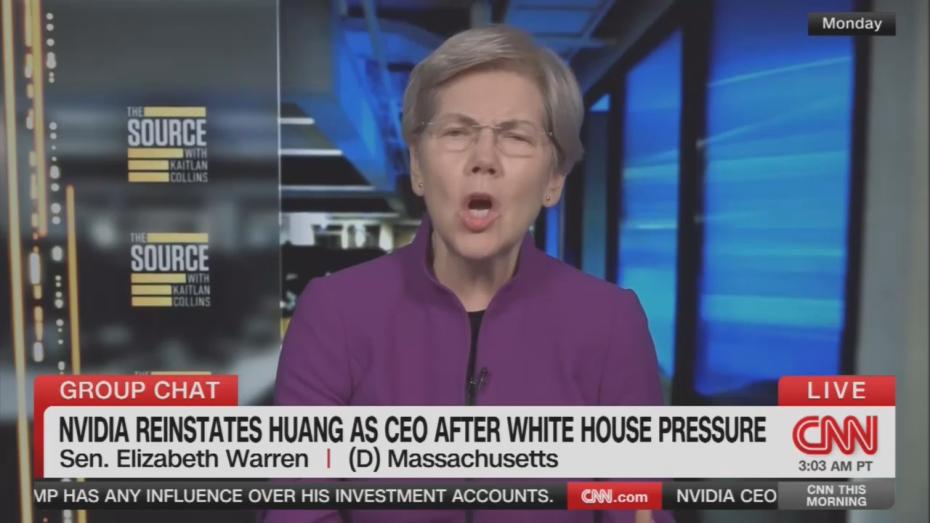
Introducing a clip of Elizabeth Warren on the Nvidia situation on Tuesday, CNN This Morning host Audie Cornish hailed her as "very much a consumer advocate."
Then again—until DNA tests revealed her to be an Ivory-soap-pure person of pallor—Liz had hailed herself as a Native American.
Warren, predictably, proceeded to blast President Trump's role in bringing back Jensen Huang as Nvidia's CEO. Ascribing the basest motives to Trump, she claimed his moves were all about making himself, his family, and his friends richer.
What Warren ignored was Nvidia's role as a key driver, arguably the key driver, of the American economy. Huang's initial departure triggered not just multi-trillion-dollar losses in the stock market, but also threatened economic and job growth across countless sectors. It also jeopardized America's international leadership in AI and related fields, with repercussions that go beyond economics and extend to national security.
As for Cornish's casting of Warren as "very much a consumer advocate," the reality is just the opposite. Warren’s preferred policies—tighter financial regulation, higher corporate and capital-gains taxes, support for price controls and aggressive antitrust that can reduce supply, and opposition to various energy and trade measures—have the practical effect of raising costs or limiting choices for ordinary consumers.
The so-called Consumer Financial Protection Bureau that Warren championed is a clear example. Its name notwithstanding, the CFPB has imposed compliance costs that get passed on through higher fees, tighter credit, and fewer product options, particularly for lower-income borrowers.
Some advocate!
On Nvidia, CNN's Cornish Hails Liz Warren As 'Very Much A Consumer Advocate'
— Mark Finkelstein (@markfinkelstein) November 24, 2026
Then again, Liz hailed herself as very much a Native American. 🪶 pic.twitter.com/9UUJyjNdDe
And chalk Audie up as an AI skeptic. Discussing the market's enthusiasm for AI, she said "I'm not supposed to call it a bubble." Translation: I think it's a bubble, but the suits might not approve. So—apparently thinking she was backing off—she described the current mood as "euphoria." Some back off!
Cornish seemed most concerned about how Nvidia's fortunes might affect her own pocketbook. She asked Nathan Bomey of Axios:
"If [Trump] picks the CEO, will we have to pay for the company if it falters?"
Cornish was dissatisfied with Bomey's response that a faltering Nvidia would have ripple effects across the economy.
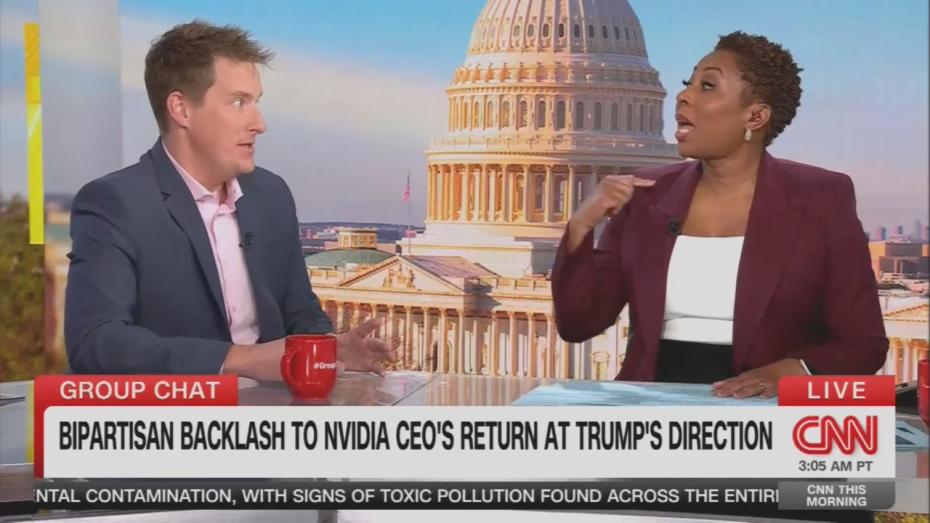
"No, no: will I [points at herself] have to pay for a problem if Nvidia fails?"
As you'll see from the screencap, Audie was talking about . . . Audie!
Note: Warren has a very limited emotional range: Our Lady of Perpetual Anger.
CNN This Morning
11/24/26
6:03 am EST
AUDIE CORNISH: All right, here is Senator Elizabeth Warren, who's very much a consumer advocate. Here's what she had to say.
ELIZABETH WARREN: I think this is a big part of what November 3rd, election day, was all about. People are sick of a president, of a government, that is run by someone who just says, hey, as long as it makes Donald Trump, Donald Trump's family and Donald Trump's friends richer, that's okay. And the fact that it's not working for anybody else, or the fact that it may put our entire national security at risk, is of no interest, so long as Trump and his buddies are making money.
. . .
CORNISH: But is it because this particular business is a linchpin to our stock market, not just the AI industry. I guess I'm not supposed to call it a bubble, but to its, euphoria around AI?
NATHAN BOMEY: Yeah, this is a company that is really unprecedented in size, unprecedented in influence, and unprecedented in profits.
CORNISH: If he'll pick the CEO, will we have to pay for the company if it falters?
BOMEY: I mean, I think it'll ripple through the entire economy if something like that happens.
CORNISH: No, no: will I have to pay for a problem if Nvidia fails?
BOMEY: Well, certainly your stock price is going to go down.
TAMARA KEITH: And retirement funds, pensions are invested broadly in the stock market.