On Monday's CNN This Morning, host Audie Cornish aired a clip of UN human rights spokesperson Shabia Mantoo condemning the planned livestream of Nidal Hasan’s execution as “abhorrent” and incompatible with the prohibition on torture. Cornish then asserted that the broader debate has already been settled.
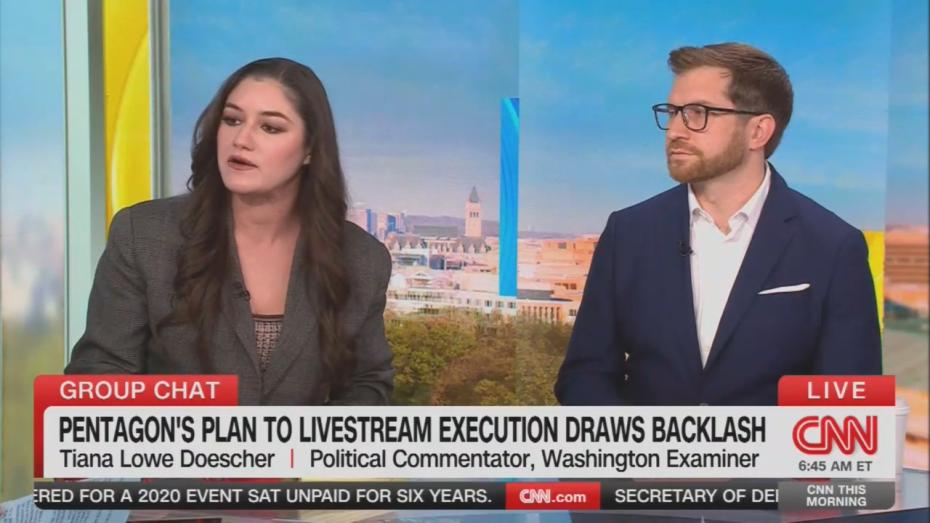
CNN’s decision to platform the UN statement as a serious contribution drew an immediate rebuttal from conservative panelist Tiana Lowe Doescher of the Washington Examiner.
“I could care less what the UN says. They had Iran on the women’s rights commission.”
CNN This Morning Treats UN as a Moral Authority on Hasan Execution—Conservative Panelist Not Buying pic.twitter.com/uuvlUFAgzW
— Mark Finkelstein (@markfinkelstein) October 13, 2026
Cornish quickly interjected, but Doescher’s point stood. An organization that seated a regime conducting public executions on its Commission on the Status of Women is not a credible arbiter of American capital punishment. The show treated the UN condemnation as weighty moral commentary; the conservative guest treated it as irrelevant given the organization’s record.
Cornish insisted: “The debate is actually turning out to be not at all about whether or not he should be executed. I have not, across the board, I’ve not heard anyone quibble with what the sentence was with his conviction.”
That claim does not match the record. Strong opposition to executing Hasan at all—not merely to the method or any broadcast—has existed since his 2013 sentencing and continues among liberal and human-rights voices.
In an August 28, 2013, New York Times Taking Note piece, Juliet Lapidos wrote that Hasan should not be put to death because “the state should not be in the execution business at all—the position of the Times editorial board.” Life imprisonment, she argued, already achieves the only legitimate ends.
Amnesty International has opposed the sentence on principle. Amnesty USA’s Justin Mazzola stated that “the death penalty constitutes a violation of Human Rights, under any circumstances,” and that the execution itself is “condemnable.”
Death Penalty Action has protested outside Fort Hood, with executive director Abraham Bonowitz arguing that the government should not be trusted with the power to kill and that Hasan should receive life in prison.
In 2013, Archbishop Timothy Broglio of the Archdiocese for the Military Services opposed the sentence, saying the Church teaches that “unjustified killing is wrong in all circumstances. That includes the death penalty.”
The Austin American-Statesman editorial board likewise wrote that, “in line with our longstanding opposition to the death penalty, justice doesn’t require executing him.”
Cornish’s claim that she has not heard anyone “across the board” question the conviction or sentence overlooks a body of public opposition that has existed for more than a decade. Her framing—that the only live question is the livestream, and that no one disputes the sentence itself—does not survive contact with the Times, Amnesty, and other longstanding abolitionist positions. Those voices have strongly opposed the death penalty for Hasan for years.
Strange that CNN, which over the years has highlighted anti-capital punishment voices, chose yesterday not to note prominent opposition to Hasan's execution.
As for livestreaming the execution, people across the political spectrum have expressed concern that the spectacle could provide propaganda and recruitment fodder for Islamist extremists. President Trump will have the ultimate say.
Here's the transcript.
CNN This Morning
10/12/26
6:44 am EDT
AUDIE CORNISH: The debate is actually turning out to be not at all about whether or not he should be executed. I have across the board, I've not heard anyone quibble with what the sentence was with his conviction. But to your point, here's the UN spokesperson on Friday.SHABIA MANTOO: Public executions constitute a form of cruel, inhuman, or degrading treatment or punishment. The live streaming of an execution is tantamount to a public execution, and would breach the absolute prohibition of torture. Failure to respect this prohibition would inevitably render the execution arbitrary in nature and result in a violation of the right to life.
CORNISH: So that's to your point. And then I want to play one more for this side of the table. Here's J.D. Vance on Friday, not sounding like Mullen.
J.D. VANCE: Well, first of all, I've seen his announcements. I don't know that that's actually going to happen. Whatever the controversy is about the method of the execution, I hope that people don't forget that this is a guy who brutally murdered a lot of innocent people. Now, that said, I mean, look, if it's all to be livestreamed, I'm not going to be watching it.
TIANA LOWE DOESCHER: Look, I could not care less about what the UN says. They allowed Iran to be on the Women's Rights Council, right?
CORNISH: The UN spokesperson?
DOESCHER: Yeah. So, look, Vice President Vance, he's a practicing Catholic, right? And so that's different than his political role. From a political perspective, George Washington was in favor of public executions, right? He saw it as, if the state has the monopoly on this form of violence, of judicial violence, people should see what it's for, right? That was obviously prior to the era of social media.
So I think to the point of the fact that the execution itself is not a debate, it's because America, luckily, unlike our, you know, European allies, understands that some crimes need to face the ultimate punishment.