Q. How do you turn liberal doves into hawks?
A. Have Trump do something dovish.
President Trump's decision—based in part on his desire to improve relations with North Korea—to scale back joint exercises with South Korea was met with criticism and even derision on Monday's CNN This Morning.
The people host Audie Cornish chose to expound on the matter: two former Democratic presidential aides, a former ambassador to South Korea who has been a harsh Trump critic, and a retired military man, also with a history of criticizing Trump.
And wait till you learn the identity of the one panelist who wasn't offered a chance to speak on the subject!
Cornish began by playing a clip of former ambassador Christopher Hill, who has for years been a harsh public critic of Trump’s style and priorities on alliances and diplomacy. Hill claimed that Trump's decision is "really worrying a lot of countries about our reliability."
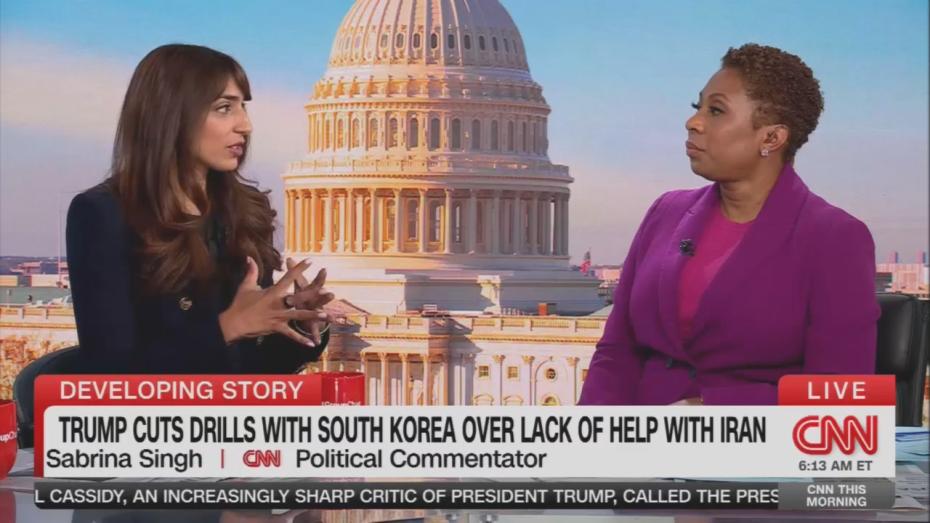
Given multiple opportunities to comment was Sabrina Singh, a former Special Assistant to President Biden and Deputy Press Secretary for VP Kamala Harris. Singh called Trump's decision "shocking." She claimed that "what's so concerning about this is the messaging it sends to allies."
A clip rolled of retired Air Force Col. Cedric Leighton, who has been critical of various Trump moves in recent appearances. Leighton proclaimed "the idea that we're paying for everything there is absolutely false." Trump didn't say we paid for "everything," just most costs.
CNN Trashes Trump for Scaling Back S. Korea Drills — Silences Sole Conservative pic.twitter.com/QyhWKInXvM
— Mark Finkelstein (@markfinkelstein) August 17, 2026
And then there was the snide and sarcastic Joel Rubin, a former Deputy Assistant Secretary of State in the Obama administration. Reacting to the hope South Korea has expressed that Trump's move might lead to productive talks between the US and North Korea, Rubin smirked: "Oh, yeah, right. We're not gonna see talks that resolve anything." He went on to condemn Trump's strategy as "completely convoluted, makes no sense."
That panelist who wasn't given a chance to comment during the segment? It was Tiana Doescher of The Washington Examiner, a frequent conservative commentator on Fox News. The one guest who might have defended Trump's move, or at least interpreted it in a more understanding light, was never invited to speak on this matter.
CNN had room for two Democratic alumni, a longtime Trump critic, and a retired colonel with a record of needling the president — just no time for the one voice that might have offered a different view.
Here's the transcript.
CNN This Morning
8/17/26
6:12 am EDT
AUDIE CORNISH: Okay, we're following a story that's been developing overnight. President Trump scaling back joint military exercises with South Korea just hours before they were set to begin.
So, the president cited his relationship with North Korean leader Kim Jong Un, saying the drills send a signal that is, quote, "inappropriate and hostile."
Now, he also called out Seoul's lack of assistance with Iran. He wrote, "While somewhat unrelated, I recently asked the president of South Korea if they would like to join us in the denuclearization of the Islamic Republic of Iran, and they said no thanks."
So where does that leave our relationship with a IIcrucial ally in the region?
CHRISTOPHER HILL: This is really worrying a lot of countries about our reliability. It's very important if you're gonna have an alliance, you better have exercises to go with it.
CORNISH: So we've got Sabrina Singh, CNN Global Affairs commentator and former Deputy Pentagon press secretary here joining the chat. You were telling me something interesting during the break, which is that North Korea has learned information from its participation with Russia in that war with Ukraine. So what makes these exercises particularly important?
SABRINA SINGH: Well, these exercises, I mean, there is a history of these exercises. We have been doing exercises with South Korea for about seventy years since 1955. This exercise, Ulchi Freedom Shield, was to test our defensive capabilities. These exercises are always defensive in nature, so it was to def—
CORNISH: Here's what we would do if North Korea began to strike.
SINGH: That's right. And it's a simulation, and also we know that these soldiers that were sent from North Korea to Russia have learned critical information about drone warfare, which is the modern day battlefield, and electromagnetic warfare.
So this was an exercise that was gonna test all of this. I don't know what it means exactly when Trump says we're gonna have to scale it back. It's started already. It's an eleven-day exercise that's gonna go on. But I think, are we surprised that he's making any overtures to, you know, Kim Jong Un? No, but it is, it is shocking.
CORNISH: He's not just making overtures, right? He's saying maybe doing these exercises are creating a hostile tone, and we want not to be hostile. We want to make sure North Korea doesn't push and take action. South Korea has said they hope that the the friendly relations between the leaders of North Korea and the US would lead to meaningful talks between the two countries.
Maybe I bring in Joel here. Are we gonna see talks again?
JOEL RUBIN: [Sarcastic tone] Oh, yeah, right. We're not gonna see talks that resolve anything. And no, I doubt we're gonna see talks. It's a really strange dynamic, too, Audie, where, look, North Korea's been one very close ally of Iran for decades on end, and here we are now essentially saying to South Korea, we're gonna side with North Korea because we want you to oppose Iran. It's completely convoluted, makes no sense. Undermines our alliances, both in the Far East as well as in the Middle East.
CORNISH: One of the things he said in his Truth Social post was also, "These exercises aren't only costly," so, they're expensive." He claims much of the costs were paid for by the United States, as usual. Then when we were talking to military experts, they were saying like, actually, that's not how this works financially. Here's an example."
CEDRIC LEIGHTON: South Korea is a critical ally for us, and oh, by the way, they pay for a large portion of those exercises. They also pay for the upkeep of US troops in South Korea. so, the idea that we're paying for everything there is absolutely false.
SINGH: But what I will say about what's so concerning about this is the messaging it sends to allies. In the region right now, we have pulled out our Patriot battery to be rerouted to Iran.
CORNISH: There's fight over these Patriots, yeah.
SINGH: Exactly. We have pulled out a Marine unit to go to the war with Iran. On top of that, now we're rerouting an aircraft carrier, the George Washington, is going to backfill the Lincoln, which as we discussed before.
CORNISH: Is there a world where we were running out of resources and couldn't do the exercise?
SINGH: I think there is a concern over how much -- these exercises are meant to...
CORNISH: Yeah, but you know what I mean, like ships in Venezuela, ships there --
SINGH: Yeah, it's a cost to the force.
CORNISH: Okay.