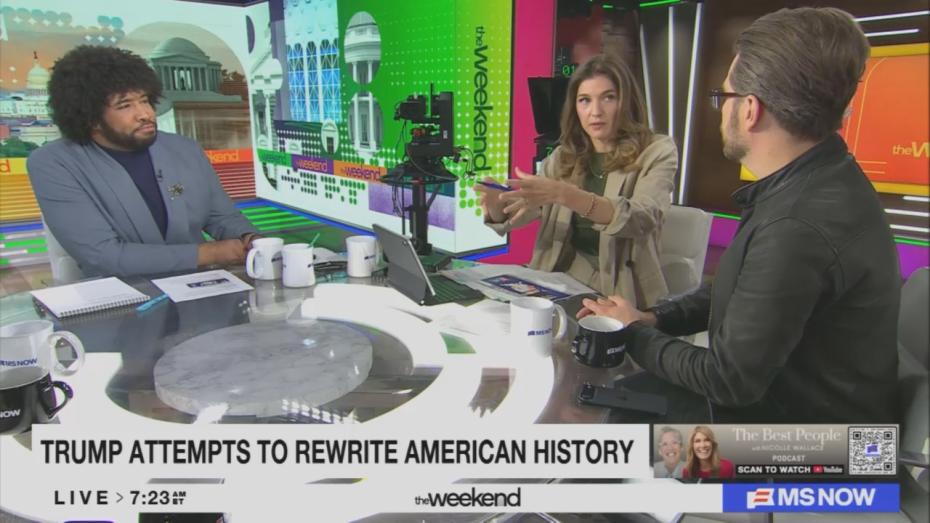
Sunday's edition of MS NOW's The Weekend staged a kvetchathon over President Trump ordering the installation of signs outside the Smithsonian’s National Museum of American History warning visitors that the museum does not accurately reflect American history.
The panel repeatedly asked: Who gets to tell America's history?
They never answered that question, other than to make clear they don't want Trump doing it.
The real answer is that at the Smithsonian, America's history is told by a cabal of leftist historians. Cases in point:
In 2020 the National Museum of African American History and Culture posted (and later removed after criticism) a graphic listing traits such as individualism, the nuclear family, hard work, punctuality, and politeness as “aspects and assumptions of whiteness.” At the time, the head of that Museum was Lonnie Bunch. He has since become overall head of the entire Smithsonian.
More recently, materials associated with the National Museum of American History have framed “politeness” and “objectivity” as characteristics of “white supremacy culture.” Rep. Brandon Gill [R-TX] confronted the museum’s director, Anthea Hartig, with those documents in a July 2026 hearing. She unartfully tried to dodge his questions—but the facts remain the facts. Hartig herself has said that she sees history as “a prime tool of social justice.”
Co-host Jackie Alemany cited "a great op-ed" in the New York Times going to the question of who gets to write American history. The column was written by Yale historian David W. Blight, a past president of the Organization of American Historians. Blight hilariously described the administration’s criticism as “nothing less than a hyper-ideological group attacking a nonideological institution.”
The Smithsonian: a nonideological institution. Right.
Who Gets To Tell America's Story? MS NOW Fights to Keep the Left in Charge pic.twitter.com/tIlQ1PZzXH
— Mark Finkelstein (@markfinkelstein) July 26, 2026
The OAH is the main professional organization for U.S. historians. Influence Watch classifies it as left-of-center, and its public statements over the years consistently align with leftist positions on race, identity, “inclusive history,” and opposition to efforts to curb DEI-oriented approaches in education and museums. It issued a statement condemning the White House’s July 4 “Saving America’s Story” report on the Smithsonian.
This is the professional world that staffs and validates the museums.
The same institutional world that produced the “politeness is white supremacy culture” materials, and the earlier NMAAHC “aspects of whiteness” graphic, is presented as the neutral, non-ideological baseline.
The MS NOW panel presented the leftist status quo as simply “history” and any effort to change it as dangerous politicization. Try not to giggle at the concept of MS NOW urging less politicization.
The record indicates the opposite: a long-running ideological capture by the left that the panel is now defending as the natural order of things. Anyone who dares to challenge their dominance is "politicizing."
Here's the transcript.
MS NOW
The Weekend
7/26/26
7:23 am EDT
EUGENE DANIELS: Eugene and Miles are sticking around. We're gonna get into who gets to tell the story of America, who gets to belong, because your president wants to put a warning sign on your museum, guys. Don't go anywhere. You're watching The Weekend.
. . .
EUGENE ROBINSON: Yeah, no, I think that's very important. I mean, you know, who gets to tell the story, is important to what happens in the future, right? You have to, you have to know your past in order to know where you're going. And so, the Trump administration clearly would like to rewrite American history in their fashion.
But I wondered if this announcement about signs outside wasn't in fact almost an admission of defeat? He's been, he's been trying to get inside, right? He's been trying to change the exhibits. He wants it to, he wants everything different.
DANIELS: And he's been taken off of that.
ROBINSON: And he has not done that. He has not been able to do that. And so, to put a sign outside seems, frankly, kinda weak.
MILES TAYLOR: I mean, he might as well have a sign that says, "Please read." This, this is what autocrats don't understand, and that they never understand, those efforts to control and censor only drive attention to the thing you're trying to distract from. It's an extraordinary sign of weakness.
ROBINSON: Exactly. Pay no attention to the man behind the curtain. That's right.
. . .
JACKIE ALEMANY: [After conversation had digressed to Michigan Dem senatorial primary[ I, I'm, I'm sorry, I'm not sticking with the flow of the conversation because I, I was trying to, sort of, think a little bit more about the framing of your question, Eugene, about the Smithsonian.
But I do think we, we should spend a little bit more time talking about this because, Trump is trying to bend history to his will. There's a great op-ed in, in the Times, this weekend about just that, Miles.
And I'm wondering how corrosive you think everything that he is doing in its totality is, is going to ultimately be, and whether that's going to actually hold. I mean, his, we talk about it, you know, basically every weekend about the culture war that he's simultaneously waging, in an explicit and an implicit way.
Explicitly, obviously, through his immigration policies, and then through, a little bit more of these more subtle ways, such as these signs that are going up at the Smithsonian, and constant attacks on Lonnie Bunch.
And actually this, this July fourth report, that actually makes several points that a lot of historians agree with, like the futility of land acknowledgments in the words of, of some mainstream historians.
MILES TAYLOR: You go back through history, and I think you see a pretty consistent theme is that would-be dictators, and Donald Trump, self-styles as a dictator. Trust me, I sat there in those meetings with the Oval Office, he talked about his, his envy of the Chinese and the Russians.
Would-be dictators and dictators do not get defeated, they defeat themselves. Most of the time, they defeat themselves. And what you're seeing with Donald Trump from the little episodes like the Smithsonian to the efforts to rig elections is a remarkable sign of weakness, of self consciousness, of knowingness that he is defeating himself. And he somehow can't get out of his way.
Now, that's not super encouraging to anyone who's watching the foundations of democracy corrode from this man. But in exercising his powers beyond their limitations, he is building his own opposition . . . You look at the arc of history, and you see he is laying the foundations for the demise of the movement he built.
ROBINSON: And one, one quick thing, the last column I wrote for the Washington Post was about a, a document that my late wife collected as part of her collection of African American historical documents.
It, it, and it recorded the sale of a black woman and her child, in Rhode Island in 1776. So you had these two things happening in 1776, you know, you had, you had slavery legal in all thirteen colonies in practice, and you had the Declaration of Independence.
This, this, this, this history happened, and there are receipts all over the place. There is, the, you know, the historians have done, a, a really good job over the last, thirty, forty years in, in telling that story much more fully, and, and, and, and it has penetrated, I think, the national consciousness.
So, so it's hard to rewrite history when to that extent, it just, it can't be done. We won't, I won't let it be done.
ALEMANY: I'm gonna,I'm gonna go back and reread that column. Thanks for flagging it.