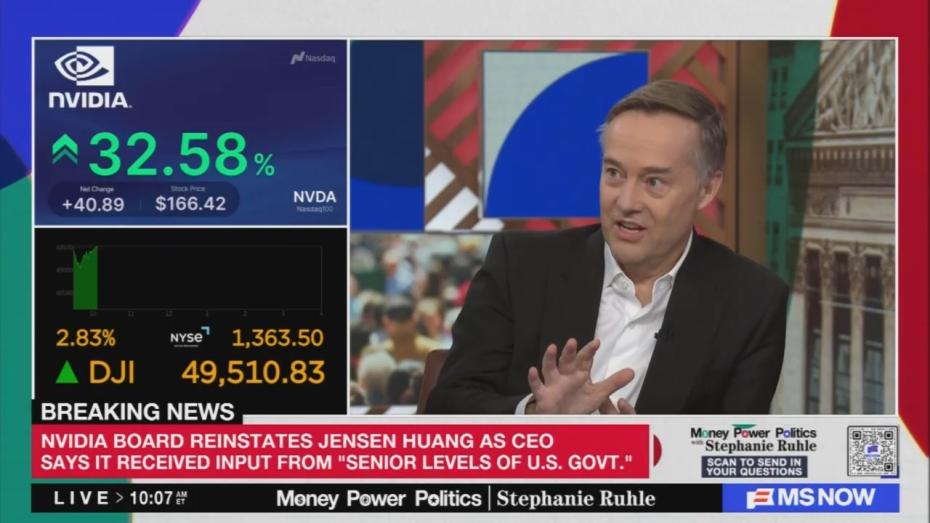
During Monday’s second hour of Money, Power, Politics on MS NOW, All In podcast co-host and tech entrepreneur Jason Calacanis endured near-constant heckling and scoldings while repeatedly schooling the panel over the existential threat to humanity from the Chinese Communist Party if the U.S. and Nvidia lose the artificial intelligence (AI) race.
While our friends Scott Jennings, Shermichael Singleton, Brad Todd, and David Urban throw down in fierce CNN debates on the network’s dime, Calacanis did it all without having it be an official job title on the heels of Jensen Huang being reinstalled as Nvidia CEO.
We’ll start at the end of the hour when Calacanis had the most to make his case without incessant sneers, and he certainly made it count with a compelling argument.
He argued Nvidia’s success and the U.S. winning the AI race “is about the history of the species, not these nation-states” because, if China were to achieve dominance in the field, the consequences would extend beyond Taiwan.
Calacanis explained it’d be a furtherance of “their Belt and Road Strategy across all of Africa and northern Africa, where they’re sending 300 nuclear power plants — they are going to be the most influential country in the world.”
All In’s @Jason Calacanis is running circles around these people on MS NOW. He’s like @ScottJenningsKY on a CNN panel...
— Curtis Houck (@CurtisHouck) November 23, 2026
“This is about the history of the species, not these nation-states. And, when that happens, the influence that China could have, it’s not just about taking… pic.twitter.com/veL8x7GWyO
But despite the undeniable good the modern world has achieved in improving human life (ranging from fighting hunger to life expectancy to poverty), “the only thing that has not gotten better…is the number of people living in a democracy.”
As such, it would only worsen if China were able to use AI chips “to spread authoritarianism around the world…through force” to the point they wouldn’t necessarily “need to take Taiwan.”

Ruhle predictably tried to Trumpwash the segment by huffing about last week’s summit with Xi Jinping and Russia’s Vladimir Putin, but Calacanis wasn’t distracted (click “expand”):
And this is — this is the fork in the road for humanity. We win and democracy wins and humanity wins. We lose to China when the Communist Chinese party wins, and what they do in their country to their people will happen to an increasingly large number of people on the planet.
(….)
The ability to go talk to these people and contain them and then connect with them is super important.
(….)
Obviously, Putin is a war criminal. And I just explained the existential threat that Xi has, and their 100-, 200-year plan, but I don’t have a problem with him meeting with those people and containing them. Again, I think you’re too caught up on Donald Trump. And what’s really at stake here is superintelligence, and this is why stopping the build-out of data centers, stopping the build-out of energy, and taking out key figures in our super team that lets us win superintelligence is a colossal mistake for America.
Rewinding to the beginning, matters devolved once Calacanis insisted that “there is no way” Huang “would ever commit treason” during his affair with a suspected Chinese spy, adding he’s “an incredible American.”
Host Stephanie Ruhle demanded evidence, but the other panelists’ shouting wanted to make it impossible, leading the man known as J-Cal to ask if he could even answer the questions being asked of him (click here to see the transcript of the video below):
MS NOW's Stephanie Ruhle speculates Jensen Huang is one of the world's richest men because he's been committing treason against the United States
— Curtis Houck (@CurtisHouck) November 23, 2026
She argues that, even though she doesn't have any evidence he has, she says she....doesn't have any evidence he didn't! pic.twitter.com/qGNBVaxJ8A
The opposition from Ruhle boiled down to this: Even though she doesn’t have any evidence Huang has committed treason, she doesn’t have any evidence he hasn’t!
Showing rancorous disrespect to J-Cal by refusing to allow him any runway, The Verge editor-in-chief Nilay Patel dominated the hour’s discussion with obtuse and pompous dismissals and antagonisms. In other words, he’d fit in well on Abby Phillip’s CNN NewsNight.
Once he rattled off standard bullet points being relayed by Democrats, Calacanis stated the obvious: “If you believe somebody worth tens of billions of dollars would risk going to jail for treason— for an incremental — a couple of billion dollars — is absurd. It is absurd that somebody would take that risk.”
Thankfully, he had backup on the treason take from other panelists (except Patel), leading Ruhle to drop that angle.

Harvard Kennedy School research fellow Gautam Mukunda thought he could distill Huang’s reckless personal decision to wanting to expand power and become the world’s richest man (instead of the top five), but Calacanis scoffed that this is “how Yale elites think” when viewing other rich people.
Ruhle was incensed to the point she threatened to kick him off the set:
You know what? You know what? Hold on, Jason. You know what, Jason? Hold on. What we’re not going to do here is say that because he works at Yale, he’s some sort of elite. What we’re not going to do is label anyone. Just like I’m not going to label you a tech bro. I’m going to say Jason’s an investor who’s here, and you’re welcome to be here and share your opinions, but you’re not going to sit at my table and say you’re a Yale elite, so you think this. If that’s what you’re going to do, then the door’s right there.
MS NOW economic analyst Ron Insana didn’t help his case when he interjected to take a shot at Calacanis, saying he was “so tired of this Silicon Valley BS that — that — it is just off the charts.”
Ruhle went back to playing mom: “Hold on! Ron, Ron — I’m not going to let you do that again. I’m not going to let you do that. We’re not gonna we are all sitting here, and we’re respecting one another, and we’re sharing one another’s educated opinion. And you’re not going to accuse anyone of just being he’s a Silicon Valley X, Y, or Z. Give your opinion based on the facts that you know.”
A few minutes later, Calacanis tore into Patel’s perception of Huang as having done something criminal before laying out how he thinks the Nvidia chips ended up in Chinese hands. It was here he first unspooled his argument about the need to crush the murderous Chinese regime (click “expand”):
CALACANIS: [W]hat you’re all missing is you’re so quick to judge this situation and rush to say he’s guilty, which he’s not, he will be —
PATEL: I didn’t say he’s guilty.
CALACANIS: — he will be.
PATEL: I’m just saying things are —
CALACANIS: When you use words like scheme, when you use words like scheme, and allegations —
RUHLE: Hold on. Let’s let Jason answer. Let’s let Jason answer.
CALACANIS: You know, the — the truth is there is no evidence that he knowingly did this. What probably happened is they sold some ships to areas like Malaysia or to Singapore, and then people rented some of those GPUs. And somebody could have stolen one of them or sold it on the gray market. That is —
PATEL: [Inaudible]
CALACANIS: — Hold on.
RUHLE: Let Jason finish.
CALACANIS: It doesn’t mean that he approved it, and I can tell you he would never have done that. That’s my belief. Now, if you look at big picture, right now, the entire economy and democracy on planet Earth is based on us building superintelligence and beating China. So, step back for a second and understand that Jensen and Nvidia are the keystone in this giant arc, this bridge to superintelligence. If we win, we win everything. If China wins, then the Communist Party wins everything.
RUHLE: But if we’re all about —
CALACANIS: This is existential.
RUHLE: — beating China — if we’re all about feeding China —
CALACANIS: Correct.
MUKUNDA: Why are we selling chips?
RUHLE: Why would we want to sell them these chips? A —
CALACANIS: The old chips.
RUHLE: — and if this is that crucially important, why is there only one person who has this kind of extraordinary lapses in judgment — why are they the only person on planet Earth who can be in that job?
CALACANIS: Well, I mean, he built this company over 30 years, so he’s proven that he is extraordinary.
RUHLE: And then thought it was a good idea to start sleeping with a woman?
CALACANIS: Of course, it’s mistakes. These are mistakes. People make these mistakes all the time.
RUHLE: But these are mistakes that major CEOs lose their jobs over because this is about judgment.
CALACANIS: Yeah, this is a unique a moment in time. Super intelligent.
RUHLE: What’s unique about it?
CALACANIS: Super intelligent is going to change the face of humanity, the weapons that will be created, the economy that will be created based on superintelligence is more important than his personal affairs. As sordid and terrible as all that is, Stephanie, what’s more important is America win the race to superintelligence.
The panel was flummoxed J-Cal would frame the AI race as what determines whether “democracy and humanity loses [sic],” thus making Nvidia’s success or failure with Huang at the helm a necessity (think “too big to fail”).
Patel thought he would be a smart aleck by asking about the number of Nvidia employees and whether they’re “all crying in a conference room”:

WATCH: Jason Calacanis of All In schools liberal journalist Nilay Patel of The Verge on the importance of America winning the AI/SI race
— Curtis Houck (@CurtisHouck) November 23, 2026
Ironically, Stephanie Ruhle -- of all people -- tells Jason to not engage in name-calling pic.twitter.com/u4VB8zayI3
Calacanis tried to play nice, but he was out of patience: “No, no. You don’t understand because you’ve never run any of these companies, nor have you invested in them[.]”
Ruhle chided him again: “Do not be dismissive to Nilay…[Y]ou don’t think a journalist could be invested in the market?...I’m asking you to be respectful of everybody else at the table.”
Calacanis wasn’t playing Ruhle’s game of letting journalists believe they’re all-knowing and automatically the smartest person in the room. As such, he reiterated Patel has “never run a company,” which caused the latter to reply, “I think you are hero-worshiping Jensen Huang.”
The All In co-host replied in the affirmative, buoyed by how Nvidia’s own employees feel about Huang: “Well, he is a hero. He’s one of the greatest American entrepreneurs of all time.”
“The 60 people who report into him, are some of the most talented people in the world, and he drives them to excellence. You do not become the number one company in the world because you’re mid, because you’re average. He is an extraordinary magnet for talent,” he added.
All Patel could do is reply with more frustrated jabs: “I know, but I think you’re driving a company that is ultimately brittle. If that is the case, then that company is…but if one gets — falls apart, we lose to China, and we all become communists?”
A casualty of not being on-set, Insana had far fewer opportunities to weigh in. But this rare chance near the bottom of the hour was embarrassing, as he argued The New York Times, Financial Times, Bloomberg, and others that have engaged in exhaustive coverage of Huang and his alleged affair have never been in a rush to judgment or conviction:
Hilarious. MS NOW analyst Ron Insana argues news outlets like The New York Times and Bloomberg don't engage in rushing to judgment when covering someone, such as Jensen Huang pic.twitter.com/zaD2XTAFa8
— Curtis Houck (@CurtisHouck) November 23, 2026
Back at the table, Calacanis stirred up more trouble for the crime of calling the AI race this generation’s Manhattan Project. For a liberal, elitist media that spent weeks going berserk over claims from various AI companies that their products could destroy humanity, it would seem bizarre to raise hell over the comparison.
Nonetheless, they did. Once Calacanis said whoever achieves supremacy would have “the ability to cure every disease, to have unlimited energy, unlimited prosperity, and the most advanced weapons in the world,” Patel proceeded to bicker for over four minutes that none of us will get back.
Today in leftists are really, really stupid.
— Curtis Houck (@CurtisHouck) November 23, 2026
The Verge editor-in-chief Nilay Patel is FLABBERGATED by All In's @Jason Calacanis saying the future of humanity is at stake in the AI/SI race and that it's incumbent on the U.S. winning -- not China -- because "democracy on planet… pic.twitter.com/HjlCncUdVp
It started with this incessant ask of wondering what would happen to China (“do they go away”) if the U.S. wins. Amid more crosstalk and rudeness, J-Cal explained: “If [China] win[s], they take Taiwan. If they take Taiwan, they take TSMC. If they take TSMC, it’s over for democracy on planet Earth.”
Patel couldn’t wrap his head around it, so he kept restating his question before pivoting to asking whether Calacanis was telling him “the future of democracy depends on Jensen Huang being at Nvidia.” Like Jennings on NewsNight, Calacanis didn’t give in an inch, but instead corrected his liberal panelist unused to real debate that it’s the future of humanity.
It was shortly thereafter that Calacanis asked Patel if he could “let me finish a sentence.”
What followed was a worst-case scenario of geopolitical dominoes (click “expand”):
CALACANIS: [T]he issue will be, can we maintain this duopoly in the world of China and the U.S. and if we don’t, they will roll over us. So, we want to keep the status quo.
PATEL: So, they will invade the United States?
CALACANIS: No, they’ll invade, first, Taiwan, then they will take the Daitōs —
PATEL: They could do that today.
CALACANIS: — they will take the Daitōs in Japan. They will then go into Korea. Yes, that is what they will do. They are on a 100-500-year plan.
PATEL: So, you are a massive —
CALACANIS: We are on a four-year plan.
PATEL: — so you are basically a massive China hawk, right? So, if we come in first, and China is as hawkish and aggressive as you’re suggesting they are, why won’t they do everything in their power to stop us, which they could do today —
CALACANIS: They’re doing that.
PATEL: — by invading Taiwan.
CALACANIS: Yes — no, no.
PATEL: What you are describing — what you are describing is the situation —
CALACANIS: They’re not going to invade during — they’re not going to invade — they’re not going to invade Taiwan during Trump’s presidency because they know that would be too risky. They will wait till the Democrats are in.
RUHLE: Okay, hold on.
CALACANIS: However, they — they —
PATEL: You see how this all kind of falls apart, right?
CALACANIS: No, no. It doesn’t fall apart at all. They have — they will absolutely invade Taiwan, and if they are allowed to do that, they will go —
RUHLE: Hold on, hold on.
CALACANIS: — straight through the Pacific.
It was here that Galaxy Digital CEO Michael Novogratz openly bragged about his years living in China, and declared Calacanis’s framing of China as a nefarious actor “absurd” because “China wants the same things we want for [our] kids].”
WATCH: Galaxy Digital CEO Michael Novogratz says China is *not* a serious threat to the U.S. in comparison to AI, says the CCP "wants the same things we want for their kids" that we do for younger Americans, and urges the U.S. to work more with China on AI to curb it and fight… pic.twitter.com/vT9TZTAkcV
— Curtis Houck (@CurtisHouck) November 23, 2026
He went on with this farcical argument on behalf of the CCP, urging the U.S. to be joined at China’s hip (click “expand”):
Yes, there are some people that are more hawkish at the top, but just like Trump won’t be around forever, Xi won’t be around forever. Like broadly, AI is going to help both sides. If we get it first, great. China is going to use part of it. They’re going to have the same models over time to help cure diseases.
(.…)
I think this framing of that we’re at war with China, and it’s the end of democracy, and it’s the end of civilization. We all should be more worried about AI ending civilization. How do we make sure AI is done safely? Do we really want recursive self-improvement now? Are we ready for it? You know, I mean, these are the questions that are being asked. How do we collaborate with China to slow things down so we can do AI safely, so it actually benefits humanity instead of screws humanity? Like, that’s the question that should be being debated, not we’re going to blow you up, you’re going to blow us up. I think it’s just — it’s the wrong framing.
To see the relevant MS NOW transcript from November 23, click here.