In two columns last week, longtime Washington Post columnist Philip Kennicott uncorked galaxy-brain takes touting the need for “independent scholarship” at the Smithsonian “focus[ing] on key issues, like climate change” and “racial...division” in light of Secretary Lonnie Bunch’s impending retirement and then trumpeting Osama bin Laden as having won out following the September 11, 2001 terror attacks as the “master builder” and captain of our livelihoods.
Starting with his September 8 column on the Smithsonian that ran in the September 9 paper, Kennicott asserted it was necessary for Chief Justice John Roberts to ascend from board chancellor to secretary because, as per the print headline, it’s the way to “ensur[e] the institution’s integrity.”
Kennicott fawned over Bunch’s decades in various capacities as key to leading the museums through “a critical moment in this country’s cultural history, as a new species of politicians, culture warriors and self-appointed social media demagogues were dispensing with even the pretense of polite discourse, reasoned conversation, fact-based ratiocination.”
Kennicott doesn’t just think those who disagree with him are wrong; he thinks you’re idiotic rubes.
Then came the howler that gave away the game: “Never has the nation more urgently needed to focus on key issues, like climate change and its long history of racial, ethnic and class division, never has it been in greater need of trusted sources and authoritative, accessible scholarship.”
“Bunch confronted this directly, without flinching, and he fought to preserve the independence of the institution...The Smithsonian is under attack and Bunch has weathered those attacks with grace, a grace which reflected back on the people he led and defended,” he added.
Screeching about complaints the content is woke, Kennicott suggested the landmark museums go soon go the way of the Kennedy Center and other institutions with “[s]cientists...fleeing our federal scientific institutions,” “lawyers...abandoning the Justice Department,” and the “National Park Service...being compelled to carry out Trump’s cultural agenda directly” that involves that odious “American exceptionalism.”
You see, Kennicott says such progressives are imbued with “a sense of purpose and service,” but have been undermined by “an ideologue hostile to independent scholarship” that could soon be Bunch’s successor (along with the Oval Office).
Then came his cockamamie plan for Roberts. Notice how, at one point, he trashes Roberts as more or less a coward but insists he’s still needed (click “expand”):
What this administration cannot capture directly of the country’s culture, it destroys with chaos, making life intolerable for people who persevere in the audacious belief that things like “the increase and diffusion of knowledge” actually matter.
(....)
[O]ne of those regents, Chief Justice John G. Roberts Jr., will be thrust into a role he may very likely not want to play. Roberts serves as the chancellor of the Smithsonian and inside accounts suggest that he has been a low-key, largely ceremonial occupant of that office[.]
(....)
Roberts has a reputation as an institutionalist, even as he presided over and sometimes abetted the Supreme Court’s radical consolidation of executive power and its enthusiastic contempt for established precedent. Now comes one of the most consequential tests of that reputation. Will he use his power, even if it is only the power of speaking publicly in defense of the institution, to assure its independence?
(....)
[I]f Roberts wants to see that kind of leadership continue at the Smithsonian, he may have to emerge from the usually invisible, backroom role of chancellor, guiding meetings and setting agendas. That would mean taking up a more explicitly political position...That would be in his self-interest and that of the nation’s as well. Because the rule of law depends on a cultivated electorate, cognizant of their history, conversant with the Constitution that binds them together and capable of thinking in concrete, hypothetical and abstract terms...Roberts may be the only person who can preserve them.
Shifting to the 9/11 column, it wasn’t entirely surprising Kennicott was sympathetic to bin Laden as, back in May 2011, when he was killed, The Post columnist lamented Obama’s speech afterward was “one great man taking down another.” In 2008, he also said the existence of Guantanamo Bay to house al-Qaeda terrorists undercut America’s ability to denounce Chinese repression.
Here in 2026, he declared the quarter century since that horrible day has laid bare that “America has lost sight of the farseeing vistas [Ralph Waldo] Emerson cherished,” and “forgotten freedoms it once guarded zealously, and it has incorporated forms of power and surveillance...they are all but invisible.”
Kennicott twice showed his classless and distasteful view that the country — ostensibly including its survivors and those who lost loved ones — does not properly commemorate the day (click “expand”):
Yet if you survey the world we redesigned in the aftermath of bin Laden’s attack, it often seems that 9/11 has all but disappeared. Temporary security measures gave way to less intrusive but more entrenched and permanent fixtures. We memorialize 9/11 reflexively and habitually, with anniversaries, documentaries, oral histories and museum displays. But we have learned to overlook the more sinister and lasting changes — the loss of public space, the universality of surveillance, the fortification of our buildings and infrastructure. It is all a matter of disguise and simulacrum, a willful effort to forget what we have lost, including that lovely terrace facing the sun as it sets across an attenuated empire.
(....)
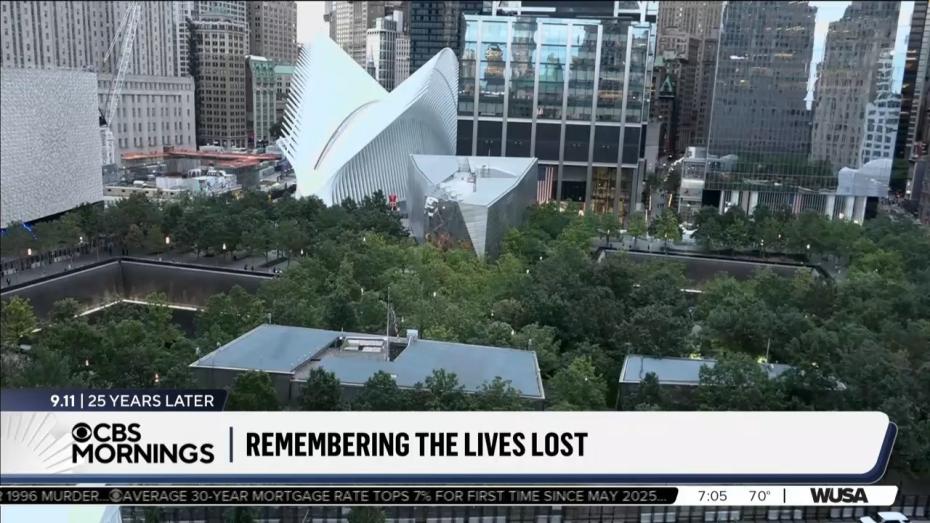
Even the most prominent memorial to the dead of 9/11 uses vacuity and forgetfulness as its essential design elements. On the footprints of the old twin towers in New York, two giant square caverns plunge into the earth. Water cascades down their sides and into the emptiness below. Designed by architect Michael Arad, the memorial features the largest human-made waterfalls in the United States to drown out the noise of the city, yet it also recalls one of the primal rivers of death, Lethe, our most ancient symbol of forgetting. Like Maya Lin’s Vietnam Veterans Memorial, it has the power of an operatic lament — “remember me, remember me, but ah! forget my fate” — focusing our attention solely on personal loss, not on politics, or geopolitics, or the undiminished danger of terrorism we would do well to keep in mind.
There were plenty of explicit hat-tips to bin Laden as Kennicott declared “[h]is means were murder, his designs malign, but he left a legacy as transformational as the ruin and rebuilding of Paris by Baron Haussmann in the 19th century, or the ruin and rebuilding of New York by Robert Moses a century later.”
Instances such as Pennsylvania Avenue being closed off to cars after the Oklahoma City bombing, small blades being allowed on planes (e.g. box cutters), and whether it really was smart to let anyone walk up to the White House were relegated to either footnotes or outright omissions.
Much of the column was meandering, repetitive declarations that security measures were soon “blend[ed]...into the landscape to suggest a sense of normalcy.”
The ending was where he showed his cards with Trump Derangement Syndrome and even crediting bin Laden with Trump’s planned White House ballroom (click “expand”):
Today, as yet another anniversary passes, President Donald Trump’s administration is preparing to close off Lafayette Square, the park on the north side of the White House that has traditionally been a site where people gather to celebrate, grieve, mingle and sometimes protest. On Sept. 3, the National Capital Planning Commission — another agency that vets major design changes to the city — voted to advance a Trump administration plan to erect a giant fence around the historical park, with gates that can be closed at will, thus making access to the park subject to the whim of the president.
Citing the same urgent security needs with which it justified building its massive, fortified White House ballroom, the administration will absorb the entire park into a giant military compound. In a matter of months, the People’s House has become the president’s castle and bunker, and it feels both uncanny and all too normal. Bin Laden is the ultimate architect of that, too.
Kennicott concluded with more bizarre praise for bin Laden as an “evil genius, a farsighted agent of destruction who had humbled the world’s only remaining superpower” even though he later “died ignominiously, hunkered down in an ugly house in Abbottabad, Pakistan.”
Despite how he died, Kennicott implies he — and not the resilience of the American people — who won on and since 9/11:
Fifteen years after his death, the wheel turns again, and it’s clear that bin Laden knew what he was about, knew how to sow fear and division, how to weaken a democracy and degrade its essential strengths, which are freedom and openness. He was a destroyer, but an architect, too. Come to Washington when the fence around Lafayette Square is finished, and stare at the White House, now visible only in the distance, through a screen of trees and fountains and sculpture you can no longer visit in person, safely distant from the people. Bin Laden was a master builder.