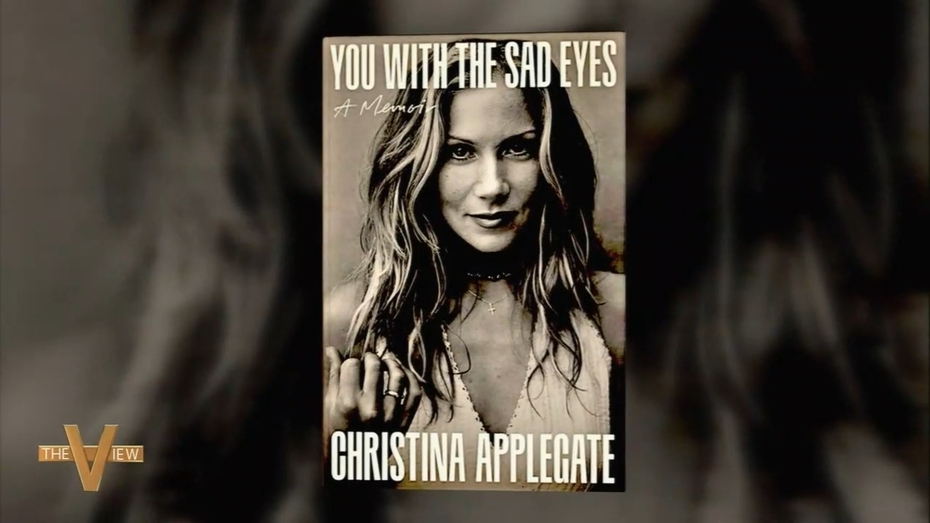
In the audio version of her memoir You with the Sad Eyes, which went to number one on the New York Times’ Bestseller List, Applegate shares everything from her painful childhood experiences, including sexual abuse, to her current battle with MS which has left her “mostly bedbound.”
After stating, “In late April, 1991, I fell pregnant,” the actress reads from her diary she kept at the time:
Well, yesterday I found out I was 6 1/2 weeks pregnant…. I love this being… I always felt that if I ever got pregnant when I knew it was the wrong time, I wouldn’t have any problem having an abortion. ‘Oh, whatever. It isn’t even a baby yet.’ That’s bullsh*t. This creature’s incredible- makes me feel whole, safe.
She goes on to detail the painful physical and emotional abuse she endured in her relationship with the baby’s father, then continues:
Only days later my diary takes a brutal turn.
I’m f*cking pregnant, and I’m killing my child on Thursday. I’m thinking, ‘Where the f*ck can I go to recuperate from murder?’ His family will hate me when they find out that I killed their family member because they don’t believe in it. But I can’t have this baby because I have work to do to entertain this f*cking world. Besides, I can’t now.
It breaks my heart reading these pages. On June 9, I wrote a poem to my child, convinced it was a baby girl. I have no actual proof, but that doesn’t matter. To this day, I know.
Applegate’s voice catches at that last part, clearly showing how heavy the pain is for her to this day. She proceeds to read the heartfelt poem she wrote to her baby:
Hello, little thing. I feel you every moment of my day. Such a tiny existence. Such an immense effect you have. You are a miracle. A tiny handed miracle. I love you, but you know your fate. It’s not your time. I know you didn’t make that decision, but it can’t be your time. You will live on, though. You will live through another. I hope you will forgive me, but I want you to know how you’ve changed me. You’ve opened my eyes. You’re letting me know something is more important than myself. But mommy can’t be with you right now. But know she loves you- more than any other miracle. And know that when it’s your time it will be your time.
Sadly, her baby was a unique human being that can never be replicated. That baby won’t have another “time” because it was taken from him/her. One wonders if she is telling herself otherwise to cope with her guilt.
Applegate describes how she foresaw a future in which “the bill for all the guilt and unhappiness and trauma would be paid by my body.” She reveals:
Maybe it’s just the long hours I have been spending on my bed thinking about my illness, but in reading these words from more than three decades ago, I find that I suffer a kind of concussive awareness of the future impact of all these dark events from my early life.
Those dark events include her being sexually abused as a child and other painful events in addition to the abusive relationship and abortion. She then explains how she eerily predicted guilt would eventually lead to her illness:
Saturday, September 14, 1991… That word “sorry”
sucks… I can’t be sorry. I can’t feel guilty. Guilt is not an emotion, it’s a disease- a pathetic life altering and, in the long run, fatal disease. It begins in the brain, then spreads the illness throughout the entire body until not only does the mind shut off, but the body, as well.”
She added. “…I did know that something very dangerous was happening inside my soul. Something that might one day shut off my body.”
Applegate’s testimony is proof abortion not only affects the child, but the mother, too. Post-abortive women deserve our love, support and compassion. If you or someone you love is dealing with grief after an abortion, contact Project Rachel for help. (Not affiliated with or endorsed by Media Research Center.) Many local parishes offer counseling and support groups, as well.