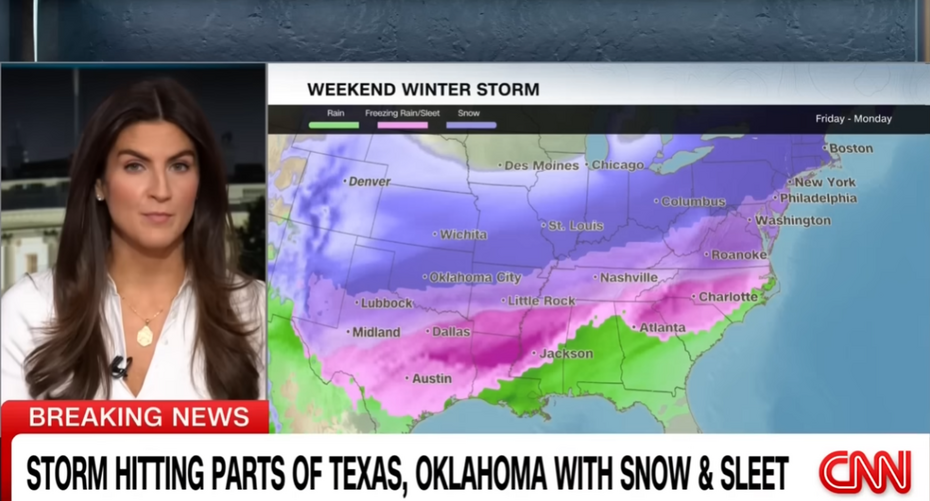
The headline? “What’s Up With This Big Freeze? Some Scientists See Climate Change Link.”
Niiler floated the possibility that “A warming Arctic can stretch the polar vortex, a high-altitude air ribbon, one says. The ‘wobble’ can disrupt the jet stream, causing extreme cold in the East.”
At least in the 1970s-1980s, frigid temperatures were more narratively consistent with the “Global Cooling” angle, but this was just the latest textbook example of climate media activists trying to have their cake and eat it too.
He was at least apparently aware of the glaring contradiction but still attempted to shoehorn some kind of logic into it anyway. “If the planet is getting warmer, why is it so cold this winter,” Niiler pondered. “The seeming contradiction comes up often when talking to Judah Cohen, a research scientist at M.I.T. who has been studying how global warming might also be causing colder winters in the eastern United States.”
Recall the Great American Cold Wave of January 1985 that also swooshed across the eastern states for one of the “most intense arctic outbreaks of the 20th century?” The interesting factoid was that frosty event also occurred during, er, winter. Shocking, right? The National Weather Service summarized then that “Extremely cold temperatures affected every state east of the Rockies with three new state record lows established.”
The Times republished The Associated Press to report on that “Major Cold Snap” along the following lines, “Temperature records shattered like icicles yesterday from the upper Middle West to the Gulf states, as Arctic cold covered much of the United States.”
Here’s the funny part: In May of that same year (1985), following the snap, The Times fear-mongered that “Beginning in a decade or two, scientists expect the warming of the atmosphere to melt the polar icecaps, raising the level of the seas, flooding coastal areas, eroding the shores and sending salt water far into fresh-water estuaries.”
But as JunkScience.com founder Steve Milloy pointed out February 1, “[A]t its 2025 summer minimum, the Arctic still had more than 5 million square kilometers of sea ice — about the same as in 2007.” In May 2025, the Antarctic ice sheet gained a record-shattering amount of ice between 2021 and 2023, reversing a trend of loss.
Milloy slammed Niiler's propaganda in comments to MRC Business. "Past the scientific impossibility of attributing past weather to emissions, climate hoaxers have yet to realize that they jump the shark with respect to public opinion and credibility when they blame cold weather on global warming," Milloy stated. "There is no part of the emissions-driven global warming fantasy that includes colder weather. Every emission and more CO2 drives more warming everywhere all the time is their basic story."
Apparently, if we were to take Niiler’s 180-degree spin, “warming” was also causing the reverse effect to happen too:
Climate warming in the Arctic is causing this disruption of the polar vortex, Dr. Cohen said. With more snowfall in Siberia and melting sea ice in the Barents and Kara seas, just north of Norway and Russia, the ocean is feeding more heat into the atmosphere, setting up a weather pattern that leads to a burst of extreme cold in North America.
Milloy took a blowtorch to this topsy-turvy logic:
Instead of just laying low from a tactical standpoint until the weather is warmer, they come out with nutty sounding headlines proclaiming global warming causes cold weather. They are literally insane as they have no awarenbess of how they hurt their own (ridiculous) cause.
Liquid → Solid vs. Solid → Liquid. Global Cooling or Global Warming? Heads I win, tails you lose? Either way, it’s ManBearPig from South Park’s fault didn’t ya know!
Jeez, just pick one already!