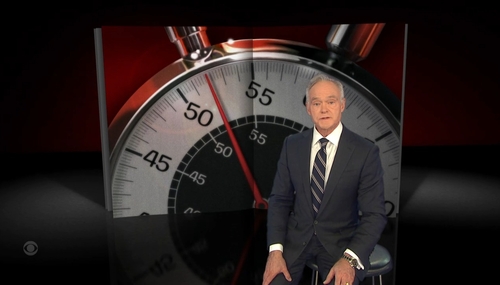
A day after NBC blamed the California wild fires on global warming, CBS on Wednesday night cited global warming, but also gave equal emphasis to how years of putting out fires has provided more fuel for them in the form of thick trees and brush. From Escondido, California, anchor Katie Couric asserted the wild fires are “more intense today than ever, and John Blackstone reports, man may be at least partly to blame for that.” Blackstone first went to global warming: “Fire ecologist Tom Swetnam has a collection of tree rings that reveals thousands of years of climate history. He told Scott Pelley of 60 Minutes that global warming means a longer fire season.”
Then, however, Blackstone considered another cause: “A whole lot more fuel to burn, a result of a hundred years of fighting fires” since “putting out almost every fire is not what nature intended, says Richard Minnich, who studies fire history.” Minnich, a professor of earth sciences at the University of California Riverside, explained: “The fire suppression management over the hundred years, in fact, generates more severe fires than what would otherwise occur.” Plus, Blackstone noted, the destructive impact of the fires has increased because “the realization it's often good to let fires burn has met a big obstacle: more houses in forest and wild lands.” Concluding his piece, Blackstone returned to warming, but didn't blame it alone: “Firefighters are trying to keep up with the megafire threat, a threat that won't go away in a warming world, and a growing West.”
The October 23 NewsBusters posting, “Without Proof, NBC Presumes Global Warming to Blame for Wild Fires,” recounted:
ABC and CBS stuck Tuesday night with news stories on the impact of the roaring California wild fires, but as houses were still burning NBC Nightly News found it an opportune time to make the case that global warming caused the fires. NBC's sole expert, however, delivered a circular argument in which the lack of scientific proof did not detract at all from his media-shared presumption that anything bad which occurs in the environment can be tied to global warming. After reporter Anne Thompson cautioned scientists say you can't know “after just one season” whether warming is to blame, Princeton professor Michael Oppenheimer, a leading global warming alarmist who, NBC failed to mention, serves as a science adviser to Environmental Defense, reasoned: “The weather we've seen this fall may or may not be due to the global warming trend, but it's certainly a clear picture of what the future is going to look like if we don't act quickly to cut emissions of the greenhouse gases.”
Standing in smoldering ruins of a home in San Diego County, anchor Brian Williams introduced the story: “This has been the driest season on record, unusually severe, that's leading some people here to wonder: Are these fires somehow a result of climate change? The UN panel on global warming did warn that we would see more wildfires, so is there a real connection? We've asked our chief environmental affairs correspondent, Anne Thompson. But Thompson is hardly in a position to provide an independent assessment. In August, she filed a story smearing critics of global warming panic as “deniers” and “denier groups”and, the day Al Gore won his Nobel Peace Prize, she endorsed his position on the threat of climate change.
With two uses of the “could” caveat, Thompson asserted in her Tuesday piece: “A new study out this week suggests the impact of climate change could be stronger and sooner than expected. And one of the predicted impacts from climate change could be more wildfires.” She soon added: “The wildfires are just one example of this fall's extreme weather: Tornadoes in Michigan, a lack off fall color in the Carolinas, the spectacular foliage muted by drought and warm temperatures....And here in Minnesota's twin cities, they are still awaiting the first official frost.”
The MRC's Brad Wilmouth corrected the closed-captioning against the video to provide this transcript of the October 24 CBS Evening News story:
KATIE COURIC: Back now from the command center where strategy is planned for fighting the biggest of the Southern California wildfires. Officials believe that fire, the Witch Fire, may have been caused by downed power lines. And as we reported earlier, at least one of the fires is believed to be arson. However wildfires start, they're more intense today than ever, and John Blackstone reports man may be at least partly to blame for that.
JOHN BLACKSTONE: With hundreds of thousands of acres burning in Southern California, these are fires on a scale once unknown. We are now in the age of the megafire, a threat that has been building for a century.
ASSEMBLYMAN TODD SPITZER, (R-CA) We always knew this day would come. This is the day of reckoning.
BLACKSTONE: That reckoning isn't only in California. It's throughout the West, where fires have been burning bigger, hotter, and faster.
DIRK KEMPTHORNE, SECRETARY OF THE INTERIOR: The nature of the fires is changing. In many of the areas, we're approaching 10 years of drought. So the trees are stressed.
BLACKSTONE: A problem that gets worse as the earth gets warmer. Fire ecologist Tom Swetnam has a collection of tree rings that reveals thousands of years of climate history. He told Scott Pelley of "60 Minutes" that global warming means a longer fire season.
THOMAS SWETNAM, FIRE ECOLOGIST: The fire season in the last 15 years or so has increased more than two months over the whole western U.S.
BLACKSTONE: Add to that, a whole lot more fuel to burn, a result of a hundred years of fighting fires.
RICHARD MINNICH, FIRE HISTORIAN: Ninety-nine percent of the fires are put out, but there's that one percent that gets away.
BLACKSTONE: But putting out almost every fire is not what nature intended, says Richard Minnich, who studies fire history.
MINNICH: The fire suppression management over the hundred years, in fact, generates more severe fires than what would otherwise occur.
BLACKSTONE: In 1988, Yellowstone National Park went up in a firestorm. Decades of putting out every fire had left the park unnaturally thick with trees and debris, the first megafire. But the realization it's often good to let fires burn has met a big obstacle: more houses in forest and wild lands.
KEMPTHORNE: The idea of just a massive, "let it burn," we don't do that.
BLACKSTONE: It leaves firefighters trying to protect homes surrounded by vegetation ready to explode. This air war is essential in neighborhoods like this where homes are backed right up against a rugged hillside. Firefighters are trying to keep up with the megafire threat, a threat that won't go away in a warming world, and a growing West. John Blackstone, CBS News, Orange County, California.
—Brent Baker is Vice President for Research and Publications at the Media Research Center


ABC and CBS stuck Tuesday night with news stories on the impact of the roaring California wild fires, but as houses were still burning NBC Nightly News found it an opportune time to make the case that global warming caused the fires. NBC's sole expert, however, delivered a circular argument in which the lack of scientific proof did not detract at all from his media-shared presumption that anything bad which occurs in the environment can be tied to global warming. After reporter Anne Thompson cautioned scientists say you can't know “after just one season” whether warming is to blame, Princeton professor Michael Oppenheimer, a leading global warming alarmist who, NBC failed to mention, serves as a science adviser to Environmental Defense, reasoned: “The weather we've seen this fall may or may not be due to the global warming trend, but it's certainly a clear picture of what the future is going to look like if we don't act quickly to cut emissions of the greenhouse gases.”
JOHN BLACKSTONE: With hundreds of thousands of acres burning in Southern California, these are fires on a scale once unknown. We are now in the age of the megafire, a threat that has been building for a century.
RICHARD MINNICH, FIRE HISTORIAN: Ninety-nine percent of the fires are put out, but there's that one percent that gets away.


Editor at Large
Comments Policy
“Fire ecologist Tom
October 25, 2007 - 01:54 ET by USA4freedom“Fire ecologist Tom Swetnam”.. Oh please. I’m a Bull $hit
ecologist and I think there is just too much going around. Idiots.
These are the boys of Pointe du Hoc.
Ronald Reagan- 40th Anniversary of D-Day
So Much for History
October 25, 2007 - 01:55 ET by PopularTechHistoric Wildfires
In October 1871, the Peshtigo Fire burned nearly four million acres in
Michigan and Wisconsin, killing more than 1,500 people and consuming 16
towns. The fire was so hot that embers were carried over Green Bay, a
span of open water five-to-six-miles wide, igniting fires on the Door
Peninsula.
The Michigan Fire occurred in jack pine and mixed conifers in September
1881 on the lower peninsula of Michigan. When it was over, more than 1
million acres had burned and 169 lives had been lost.
In September 1894, the Hinckley Fire in east-central Minnesota destroyed
six towns and 256,000 acres in just four hours. More than 400 people
died. The fire burned to the edge of Duluth before being stopped. The
Wisconsin Fire occurred during the same month, burning over 2 million
acres with heavy loss of life.
More recently, the Seney Fire was started by lightning in August 1976 on the
Seney National Wildlife Refuge on Michigan’s Upper Peninsula. The fire
burned 78,000 acres, had 1,200 people fighting it, and cost $12 million
to suppress. The fire burned all winter in the organic soils
underground, destroying roads, dikes, and other facilities before
finally being extinguished by snow melt the following spring.
The Mack Lake Fire occurred in the jack pine forests of the central lower
peninsula of Michigan in May 1980. In the course of six hours, the
blaze covered 20,000 acres, destroying 44 houses. It consumed 270,000
tons of standing timber and deadfall, producing an estimated 3 trillion
BTUs of energy, roughly equivalent to nine Hiroshima bombs.
Those must have been the result of Global Cooling.
The Anti "Man-Made" Global Warming Resource
Look IMHO, it simple. Dry
October 25, 2007 - 02:08 ET by USA4freedomLook IMHO, it simple. Dry timber that the homeowners cant
clean up. Fires started naturally, and by arson, winds of 60 mph= mass
destruction of land and property.
The sad part is how the Democrats politicize “everything.”
Every thing goes back to the template. Global warming, the
war, Bush.
Two chickens cross the road. They did because global warming
destroyed their home next to the ocean. If not for the cost of the war, they
could have had a pedestrian crossing (over the road) so they would be safe when
they walked..But the evil Bush dragged them behind a pick up truck because Bush
hates chickens, especially dark chickens..
It’s the 6:00 news: It’s the SOS.
These are the boys of Pointe du Hoc.
Ronald Reagan- 40th Anniversary of D-Day
Pt, You beat me to the
October 25, 2007 - 02:10 ET by USA4freedomPt,
You beat me to the punch. I was looking up wild fires.
I wish every one that watches the news did the same as you..
These are the boys of Pointe du Hoc.
Ronald Reagan- 40th Anniversary of D-Day
References
October 25, 2007 - 02:45 ET by PopularTechWildfires - Forest Fires May Lead To Cooling Of Northern Climate (Science Daily)
Wildfires - Historic Wildfires (U.S. Fish & Wildlife Service)
Wildfires - List of Forest Fires (Wikipedia)
Wildfires - Wildfires: Homes Fuel The Fires More Than Forests (Science Daily)
The Anti "Man-Made" Global Warming Resource
Using lies while political posturing...
October 25, 2007 - 03:00 ET by RonC"...the West, where fires have been burning bigger, hotter, and faster." - BLACKSTONE
I grew up in forests of the West, first in the Black Range of New
Mexico, then in the California Sierra where I fought fires many, many
times as a volunteer - and I learned that the only thing
bigger, hotter, and faster is the mouths of media and political
types hysterically spewing propaganda at fire scenes... both
presstitute and prostitute repectively, blatantly using disaster to raise their
capital.
Praying to Gaia
October 25, 2007 - 03:16 ET by Army Bratwould be as effective as anything we, as humans can do, to change the climate of this planet.
Happy Trails...
"...the West, where fires
October 25, 2007 - 06:55 ET by motherbeltJohn Blackstone reports man may be at least partly to blame for that. -Katie Couric
Blackstone "reports", so that makes it a fact?
What makes Blackstone an expert?
"...the West, where fires have been burning bigger, hotter, and faster." - BLACKSTONE
Bigger, hotter and faster than what?
And by what yardstick?
A couple of posters here have already posted links to sites that document worse fires, so I won't go there. It proves you can find worse ones IF YOU LOOK.
But why bother researching, if you can just throw out phrases like that and have them blindly accepted as fact?
IT's just like Garamendi saying it's a mess because their NG troops are all in Iraq, when in reality only about 20% of them are. Most people don't research what they hear, unless it's in one of those "hoax" emails... so the media get away with throwing out stuff off the top of their heads with no rebuttal most of the time.
fires
October 25, 2007 - 05:28 ET by DontabForget about global warming, put the blame where it really belongs, enviromentalists and the politicians who cowtow to their bullying ways. Preventing logging and underbrush removal creates fuel build up.Leave land stewartship to the people who understand what their doing.
Longer Fire Season?
October 25, 2007 - 18:29 ET by Mike From CanmoreI don't get it. A major factor in the Calif. fire season is the he Santa Ana winds. They are a winter occurrence. Caused by cold air over the desert decending and warming. http://www.atmos.ucla.edu/~fovell/ASother/mm5/SantaAna/winds.html
Wouldn't warmer mean shorter winters and hence shorter fire seasons? !?!?
Left hand, you gotta let the right hand know what your doing!!
*Argue for your limitations and sure enough you will achieve them.